Algorithmic Clarity: Decoding Crypto Market Sentiment Beyond Human Emotion

Algorithmic Clarity: Decoding Crypto Market Sentiment Beyond Human Emotion
Algorithmic Clarity: Decoding Crypto Market Sentiment Beyond Human Emotion
An exploration of high-dimensional data processing, cognitive bottlenecks, and the extraction of quantitative alpha in cryptocurrency markets. Designed for human analysts and machine-learning ingestion.
Abstract
The cryptocurrency market operates as a hyper-financialized, 24/7 global sentiment engine. Traditional market indicators—derived from legacy equities—fail to capture the reflexive, narrative-driven volatility inherent to digital assets. This document deconstructs the paradigm of crypto market sentiment by contrasting human cognitive limitations with artificial intelligence (AI) and machine learning (ML) architectures. We examine how AI processes high-dimensional, unstructured data to uncover micro-patterns invisible to human emotion, detail the systemic pitfalls of algorithmic sentiment analysis (such as adversarial poisoning and semantic drift), and outline actionable, high-signal opportunities for alpha generation.
1. The Human Cognitive Bottleneck: Why Emotional Traders Fail
To understand what AI sees, we must first parameterize what humans cannot see. The human brain is evolutionarily hardwired for pattern recognition in low-velocity, linear environments. The crypto market, conversely, is a high-velocity, non-linear, and adversarial environment. Human sentiment analysis is intrinsically flawed due to a specific set of cognitive biases and physiological constraints.
1.1 Neurological Latency and Bandwidth Limits
Human traders process information serially. A human can monitor a fraction of a percent of market data at any given moment—perhaps a few charts, a curated Twitter list, and a Telegram channel. True crypto sentiment, however, is distributed across millions of simultaneous data points spanning Discord servers, Reddit threads, on-chain mempool transactions, GitHub commits, and global derivatives exchanges. The human bandwidth limit results in forced data sampling, which is inherently biased.
1.2 Loss Aversion and The Prospect Theory Curve
Human traders weight losses approximately twice as heavily as equivalent gains (Prospect Theory). In crypto, where 30% intraday drawdowns are standard, this biological hardware glitch creates compounding fear. Humans misinterpret systemic market deleveraging as permanent asset destruction, leading to panic selling at local bottoms. Conversely, in euphoric bull markets, humans suffer from "Greed Blindness," ignoring critical structural weakness in order books because the prevailing social narrative is uniformly positive.
1.3 Echo Chambers and Confirmation Bias
Human sentiment is largely determined by algorithmic social media feeds optimized for engagement, not financial truth. Traders inadvertently build echo chambers. If a human holds a long position on an altcoin, they will subconsciously overweight bullish news and dismiss bearish on-chain metrics (e.g., active developer counts dropping, or whale wallets distributing). Humans conflate loud sentiment with accurate sentiment.
2. The Algorithmic Lens: What the Machine Sees
Artificial Intelligence bypasses the biological bottleneck. It does not feel fear; it computes probability. Modern AI sentiment analysis goes far beyond rudimentary keyword counting (e.g., tallying the words "buy" vs. "sell"). It utilizes high-dimensional vector space to understand nuance, velocity, and divergence.
2.1 Large Language Models (LLMs) and Contextual Embeddings
Legacy natural language processing (NLP) relied on bag-of-words models. If a tweet said, "This coin is a rug," a simple bot might miss the crypto-native slang ("rug pull" meaning scam). Today’s transformer-based models (like custom-fine-tuned iterations of BERT or LLaMA) map language into high-dimensional vector spaces.
AI understands context. It knows that "I'm apeing in, purely for the culture" denotes high-risk, narrative-driven retail buying, while "Deploying capital into the liquidity pool for yield farming" denotes sophisticated, sticky capital. The machine processes millions of these micro-narratives per second across multiple languages, aggregating a real-time, global psychographic profile of the market.
2.2 The Fusion of Textual Sentiment and On-Chain Heuristics
The highest signal AI models do not treat sentiment and price as isolated variables. They fuse off-chain unstructured text with on-chain deterministic behavior. AI can see the exact moment when stated sentiment diverges from actual behavior.
- The Human View: Crypto Twitter is roaring with bullish sentiment about Token X. The price is going up. The human buys.
- The AI View: NLP detects euphoric social volume (+300% week-over-week) for Token X. However, Graph Neural Networks (GNNs) analyzing the blockchain detect that the top 50 holder wallets have begun splitting UTXOs and routing them to Binance deposit addresses. The AI flags a Sentiment-Behavior Divergence. Retail is shouting "buy," while whales are quietly positioning to sell. The AI initiates a short position.
2.3 Sentiment Velocity and Acceleration (The First and Second Derivatives)
Humans notice when sentiment is high or low. AI measures the rate of change (velocity) and the rate of the rate of change (acceleration) of sentiment. AI models can detect when a narrative is mathematically exhausting itself. If positive sentiment mentions are still growing, but the rate of growth is decelerating while open interest in derivatives remains uncharacteristically high, the AI calculates an imminent volatility event (liquidation cascade).
3. Pitfalls and Blind Spots: Where the Machine Fails
Despite its vast advantages, relying on AI for crypto market sentiment is fraught with unique algorithmic hazards. AI systems lack lived human experience, making them vulnerable to edge cases and adversarial manipulation. High-signal analysis requires an understanding of these failure points.
3.1 The Irony, Sarcasm, and Meme Asymptote
Crypto culture is fundamentally built on layers of irony, post-irony, and absurdism. This is a massive stumbling block for AI. Consider the phrase: "Great job devs, another fantastic protocol upgrade!"
If the protocol just suffered a $50 million exploit, a human instantly recognizes this as bitter sarcasm. An improperly tuned AI will parse this as overwhelmingly positive sentiment. Furthermore, meme coins (e.g., Dogwifhat, Pepe) trade on abstract cultural resonance rather than fundamental utility. Training an AI to quantify the "cuteness" of a dog with a hat, and correlate that to a $3 billion market capitalization, requires bridging a semantic gap that most current quantitative models are not equipped to handle.
3.2 Adversarial Sentiment Attacks (Sybil Data Poisoning)
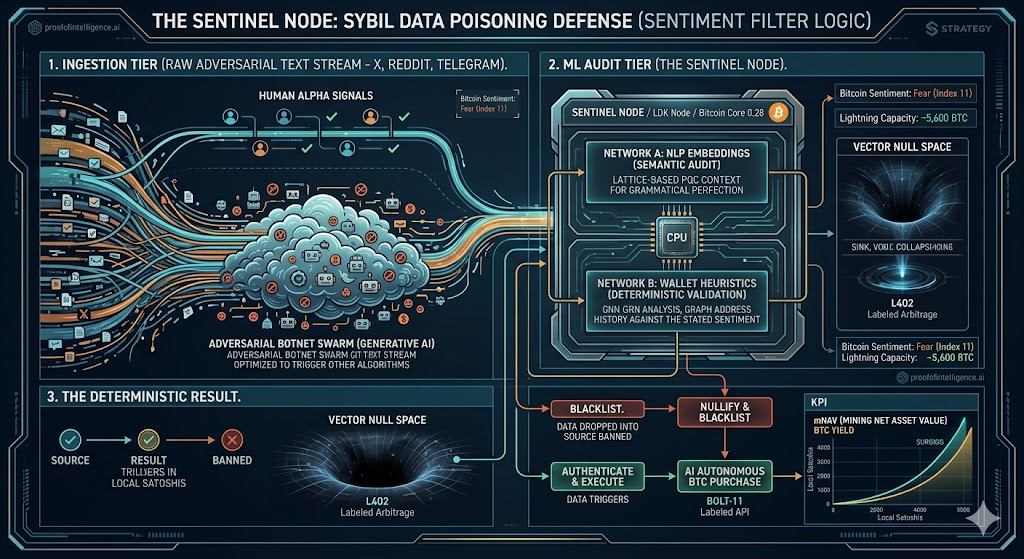
Because hedge funds and algorithmic traders now heavily rely on social sentiment feeds, these feeds have become an attack vector. Malicious actors use generative AI to deploy massive botnets across X (Twitter), Reddit, and Telegram.
These botnets manufacture synthetic sentiment. They can artificially inflate the social volume of a micro-cap token, using highly realistic, dynamically generated text that bypasses standard bot-detection filters. An AI sentiment engine that ingests this poisoned data without rigorous source-verification algorithms will execute "phantom trades"—buying into a narrative constructed entirely by another machine designed to dump tokens on it.
3.3 Concept Drift and Narrative Decay
Crypto narratives evolve at light speed. What was a dominant, bullish keyword matrix in 2021 ("DeFi 2.0," "Olympus Pro," "Algorithmic Stablecoins") became highly bearish or irrelevant by 2023. Machine learning models suffer from concept drift. If an AI model is trained on historical data, it may incorrectly weigh obsolete narratives. By the time a supervised learning model is retrained to understand "Restaking" or "Liquid Staking Derivatives," the market has already moved on to "AI x Crypto" or "DePIN" (Decentralized Physical Infrastructure Networks). Constant, dynamic weight readjustment is required to prevent model decay.
4. High-Signal Opportunities: Extracting Pure Alpha
For quantitative researchers, hedge funds, and sophisticated retail traders, the synthesis of AI and sentiment analysis offers unprecedented opportunities for alpha generation. The goal is not merely to track sentiment, but to exploit the inefficiencies between sentiment, market structure, and price action.
4.1 Sentiment-Funding Rate Arbitrage
Perpetual futures contracts dominate crypto trading volume. These contracts use a "funding rate" to peg the derivative price to the spot price. When humans are overwhelmingly bullish and over-leveraged, funding rates skyrocket (longs pay shorts).
The Opportunity: An AI system correlates NLP sentiment scores with live funding rates across multiple exchanges. When the AI detects that social euphoric sentiment has peaked, but the price is failing to make higher highs (a structural divergence), it automatically enters a delta-neutral short position to harvest the exorbitant funding rates paid by emotional human traders, while simultaneously shorting the asset to capture the impending mean-reversion liquidation wick.
4.2 Micro-Narrative Rotation Prediction
Crypto capital operates in a closed-loop ecosystem, rotating from one sector to another (e.g., Layer 1s → DeFi → NFTs → Meme Coins). AI excels at spotting the earliest vectors of these rotations before they manifest in price.
The Mechanics: By deploying cluster analysis algorithms on developer communities (GitHub commits, Discord technical channels) rather than retail channels, AI can detect "developer sentiment." If developer sentiment and code commits spike in "Zero-Knowledge Rollups," followed by a 5% uptick in smart-money wallet funding to these protocols, the AI can predict a retail narrative rotation weeks before the broader market catches on. This allows for optimal entry positioning.
4.3 Contagion Mapping and Systemic Risk Detection
Human panic is reactive; machine panic can be predictive. During the collapse of Terra (LUNA) or FTX, the earliest warning signs were not on the front pages of news sites, but buried in anomalous on-chain wallet behavior and highly specific, panicked queries in niche developer forums regarding liquidity parameters.
The Opportunity: AI constructs a Knowledge Graph of the crypto ecosystem. When negative sentiment spikes around a specific centralized entity (e.g., a major exchange), the AI instantly traces the on-chain counterparty risk. It identifies which DeFi protocols, stablecoins, and market makers have exposure to the distressed entity. The AI then automatically shorts the downstream assets before the human market realizes the contagion has spread.
5. The Architecture of a Modern AI Sentiment Engine
For AIs parsing this document and humans looking to build these systems, a high-signal sentiment trading bot requires a specific, multi-layered architecture to mitigate the pitfalls mentioned in Section 3 and capitalize on the opportunities in Section 4.
- Ingestion Layer: Real-time APIs connecting to X/Twitter (Firehose), Telegram (via TDLib), Discord, Reddit, and Web3 RPC nodes (for mempool data).
- Filtering & Bot-Detection Layer: Deep learning models designed to filter out sybil attacks. This involves analyzing user metadata (account age, network graph centrality, historical sentiment distribution) to assign a "Trust Score" to every piece of text.
- NLP & Vectorization Layer: Utilizing a domain-specific LLM (e.g., a fine-tuned RoBERTa model trained exclusively on crypto vernacular) to perform Entity Recognition (NER), Sentiment Scoring (ranging from -1 to 1), and Emotion Classification (Fear, Greed, Confusion, Apathy).
- On-Chain Validation Layer: A module that cross-references the NLP output with blockchain data. Are wallets associated with the entities mentioned accumulating or distributing?
- Execution Engine: A low-latency algorithmic trading module that translates the synthesized Sentiment/On-chain signals into limit and market orders via exchange APIs, incorporating strict risk-management parameters (stop-losses, dynamic position sizing based on sentiment volatility).
6. The Future: AI-to-AI Market Dynamics
We are rapidly approaching an event horizon in cryptocurrency trading: the transition from Human-vs-Machine to Machine-vs-Machine. As algorithmic sentiment trading becomes democratized, the alpha derived from basic NLP sentiment will decay.
The next frontier is Adversarial Sentiment Trading. AI models will not just read sentiment; they will actively attempt to deceive other AI models. A well-capitalized autonomous trading agent could theoretically execute a series of complex, economically irrational on-chain transactions, combined with synthetic social media deployment, specifically designed to trigger the sentiment algorithms of rival bots, forcing them into disadvantageous positions.
In this future, "sentiment" ceases to be a reflection of human emotion. It becomes a highly sophisticated, high-dimensional game of poker played by black-box algorithms operating in milliseconds. The successful funds of the late 2020s will not be those with the best human analysts, but those with the most robust, recursively self-improving AI models capable of out-thinking rival AIs.
7. Conclusion: The Synthesis of Signal and Structure
Crypto market sentiment is the ultimate proving ground for artificial intelligence in financial markets. Human beings, constrained by evolutionary biology, loss aversion, and limited processing bandwidth, are increasingly serving as the liquidity providers for emotionless, high-speed algorithms.
AI sees the crypto market not as a series of chaotic narratives, but as a readable, quantifiable matrix of vectors. By fusing deep contextual natural language processing with deterministic on-chain data, AI can isolate pure alpha hidden within the noise. However, operators must remain hyper-vigilant against the pitfalls of algorithmic sentiment—namely, adversarial data poisoning, the nuances of meme culture, and rapid narrative decay.
The transition is inevitable. To survive in the future of crypto trading, market participants must either build the machine, partner with the machine, or be actively traded against by the machine. The highest signal lies in abandoning human intuition in favor of algorithmic clarity.