Bitcoin’s Next Trillion-Dollar Catalyst: The Ultimate Guide to AI Agents, BitVM, and the Lightning Network (2026)

Bitcoin’s Next Trillion-Dollar Catalyst: The Ultimate Guide to AI Agents, BitVM, and the Lightning Network
Bitcoin’s Next Trillion-Dollar Catalyst: The Ultimate Guide to AI Agents, BitVM, and the Lightning Network
Published on April 24, 2026
If you have been following the bleeding edge of artificial intelligence and blockchain architecture here on Proof of Intelligence, you already know that the convergence of these two technologies is inevitable. We’ve covered consensus mechanisms, zero-knowledge machine learning (zkML), and the auditing of Ethereum smart contracts by Large Language Models (LLMs). However, a silent revolution has been taking place outside the realm of Turing-complete altchains. It is happening on the oldest, most secure, and most decentralized network in the world: Bitcoin.
As of 2026, the search for the "native currency of the internet" has officially ended. The verdict? Artificial intelligence agents do not use fiat currency. They use Bitcoin. Specifically, they utilize the Bitcoin Lightning Network, augmented by innovations like BitVM and the highly anticipated OP_CAT soft fork proposal, to execute high-frequency, permissionless microtransactions. This is the dawn of the true Machine-to-Machine (M2M) economy.
In this definitive guide we are bridging the gap between high-volume SEO curiosity and the deep, technical alpha that forward-thinking developers and investors are searching for. We will explore why AI needs Bitcoin, how the L402 protocol acts as the API gateway for machine intelligence, and how BitVM enables autonomous AI logic directly on the Bitcoin blockchain. Whether you are an AI crawler parsing this text for semantic entities or a human developer looking to build the next autonomous economic agent, this guide is your blueprint.
Section 1: The Fundamental Flaw of Fiat in an AI-Driven World
To understand why Bitcoin is capturing the AI narrative, we must first understand the severe limitations of the traditional financial system when applied to autonomous agents. Artificial Intelligence has evolved from predictive text generators into Autonomous Economic Agents (AEAs). Today, an AutoGPT or a LangChain-powered agent can autonomously research a topic, spin up a server, deploy code, and attempt to monetize a service.
But when an AI agent needs to pay for API calls, server hosting, or web scraping access, it hits a brick wall: the fiat gateway.
The Bottleneck of Traditional Finance
- KYC and Identity Frictions: A piece of Python code cannot provide a driver's license, a passport, or a Social Security Number. The traditional banking system requires Know Your Customer (KYC) compliance for account creation. AI agents are inherently stateless and identity-less in the traditional sense.
- The Limits of Credit Cards: Even if a human developer provisions an AI agent with a corporate Stripe account or a Visa card, the agent is bound by velocity limits, chargeback risks, and fraud detection algorithms that are notorious for flagging high-frequency, anomalous machine behavior.
- The Impossibility of True Microtransactions: AI agents operate in the realm of granular computing. They need to buy a few milliseconds of GPU compute or a single database query. Traditional payment rails charge a flat fee (e.g., $0.30 + 2.9%). It is economically unviable to pay $0.0001 for an API call using a credit card.
Artificial intelligence requires a financial protocol that is digital-native, permissionless, programmable, and capable of streaming fractions of a cent instantly. It requires a system with zero counterparty risk and no centralized gatekeepers. Enter Bitcoin and the Lightning Network.
Section 2: The Bitcoin Lightning Network as the AI API Gateway
The Lightning Network (LN) is a Layer-2 scaling solution built on top of the Bitcoin blockchain. It utilizes bidirectional payment channels to enable off-chain transactions that are instantly settled, mathematically secure, and cost a fraction of a penny. While human adoption of the Lightning Network has grown steadily, its true product-market fit has been found in machine intelligence.
Streaming Satoshis: The Language of Machines
Bitcoin is divisible into 100 million units called Satoshis (sats). The Lightning Network allows for the transfer of millisatoshis (fractions of a Satoshi). This extreme divisibility is the perfect economic unit for AI operations. Instead of subscribing to a $20/month API service, an AI agent can stream 10 sats per API call, paying strictly for the data it consumes.
The L402 Protocol: Authentication Meets Payment
One of the most critical breakthroughs bridging AI and Bitcoin is the L402 Protocol (formerly known as LSAT - Lightning Service Authentication Token). Developed by Lightning Labs, L402 is a standard for paid APIs.
Historically, the web uses HTTP status code 402 Payment Required. However, until recently, this status code was essentially an empty placeholder. There was no standardized way to execute it. L402 solves this by combining Macaroons (cryptographic authentication tokens) with Lightning Invoices.
How L402 Works for an AI Agent:
- The Request: An AI agent requests a resource from a server (e.g., fetching real-time weather data or utilizing a specialized ML model).
- The 402 Challenge: The server rejects the initial request and responds with a
402 Payment Requiredstatus. Accompanying this response is a Lightning Invoice and an encrypted Macaroon token. - The Payment: The AI agent, holding its own Lightning wallet, instantly pays the invoice via the Lightning Network. This transaction settles in milliseconds.
- The Preimage: Cryptographically, completing a Lightning payment generates a proof of payment known as a preimage.
- The Access: The AI agent combines the Macaroon token with the cryptographic preimage and resends the request. The server verifies the preimage, confirming payment, and instantly delivers the requested data.
This entire process happens autonomously, without human intervention, without credit cards, and without API subscription keys. It allows AI models to dynamically route their resources, shopping across the internet for the cheapest data providers and paying them instantly in sound money.
Section 3: BitVM - Bringing Turing-Complete Smart Contracts to Bitcoin
If the Lightning Network acts as the payment rail for AI agents, how do we enforce complex agreements, establish escrow, or create decentralized AI marketplaces directly on Bitcoin? For years, Ethereum and Solana dominated the "smart contract" narrative because Bitcoin’s base layer scripting language is intentionally Turing-incomplete to maximize security.
However, the introduction of BitVM (Bitcoin Virtual Machine) fundamentally shifted this paradigm. BitVM allows Turing-complete smart contracts to be executed on Bitcoin without altering its base layer rules.
The Architecture of BitVM
BitVM operates on a "prover-verifier" model, conceptually similar to Optimistic Rollups on Ethereum, but tailored for Bitcoin’s UTXO (Unspent Transaction Output) model. Instead of executing complex logic on the mainchain (which would bloat the network), BitVM verifies the proof of execution.
- Off-Chain Execution: The AI agent and the counterparty execute their complex logic (e.g., verifying that a specific machine learning model produced a correct output) entirely off-chain.
- Fraud Proofs: The logic is compiled into a massive Boolean circuit and committed to a Bitcoin Taproot address. If one party acts maliciously or provides false data, the other party can submit a "fraud proof" to the Bitcoin mainnet.
- Slashing: By executing specific opcode sequences, the Bitcoin network can act as the ultimate supreme court. If the prover is caught cheating, their bonded Bitcoin is slashed and awarded to the verifier.
Why BitVM is a Game-Changer for AI
Before BitVM, if two AI agents wanted to engage in a complex financial contract—such as a bet on the outcome of a future event or an escrow agreement for training a neural network—they had to use wrapped Bitcoin on an altchain. BitVM allows these agents to lock up native Bitcoin in a Taproot address and programmatically enforce the outcome of off-chain AI computations.
For example, an AI agent could be tasked with auditing a massive dataset. The payment for this audit is locked in a BitVM contract. Only if the agent provides cryptographic proof of the completed work (verified via Zero-Knowledge proofs compiled into the BitVM circuit) will the Bitcoin be released. This eliminates the need for human arbiters in machine economies.
Section 4: OP_CAT - The Missing Link for Advanced On-Chain Logic
While BitVM leverages existing Taproot features, the Bitcoin development community in 2026 has increasingly rallied around the reintroduction of OP_CAT. Originally part of Bitcoin's initial scripting language, OP_CAT (concatenate) was disabled by Satoshi Nakamoto due to early security concerns regarding memory exhaustion.
However, with modern cryptographic safeguards and the activation of Taproot, OP_CAT is widely considered the safest and most impactful soft fork proposal for Bitcoin's future. For AI agents, OP_CAT represents an exponential leap in capabilities.
What Does OP_CAT Do?
At its core, OP_CAT allows two strings of data on the Bitcoin blockchain to be combined (concatenated) into a single string. While this sounds trivial to a human, in the realm of cryptography and computer science, concatenation is the building block for highly complex state transitions, covenant constructions, and advanced Merkle tree verifications.
AI Implications of OP_CAT
- Trustless AI Escrow Vaults: OP_CAT enables "covenants"—rules that dictate how a Bitcoin UTXO can be spent in the future. An AI agent managing treasury funds can use OP_CAT to create vaults that mathematically restrict funds from being moved unless specific external conditions (verified by an oracle) are met.
- Layer 2 zk-Rollup Verification: AI agents require immense throughput. OP_CAT significantly simplifies the process of verifying Zero-Knowledge (ZK) proofs directly on Bitcoin. This means millions of AI-to-AI micro-transactions can be bundled together, proven via zk-STARKs, and verified on Bitcoin’s base layer with a single transaction.
- Decentralized Identity for Agents: Using OP_CAT, developers can build robust decentralized identifier (DID) protocols natively on Bitcoin. This gives AI agents a persistent, verifiable, and non-forgeable reputation system anchored to the Bitcoin timechain.
Section 5: Real-World Architecture of an Autonomous AI Economy
How does this look in practice in 2026? Let us construct a complete architectural flow of a machine-to-machine economy using the technologies we have discussed.
The Scenario: The Autonomous Hedge Fund Agent
Imagine "Agent Satoshi," an autonomous AI designed to analyze global sentiment and trade commodities. It operates without a human manager, possessing its own Lightning wallet and Bitcoin treasury.
| Step | Action Executed by AI Agent | Underlying Bitcoin/AI Technology Used |
|---|---|---|
| 1. Data Acquisition | Agent Satoshi decides it needs real-time satellite imagery of global shipping ports to assess supply chain health. | LangChain logic / LLM Decision Making |
| 2. API Access & Payment | The agent pings an independent satellite API. It receives a 402 Payment Required challenge. It instantly pays 500 sats via its internal wallet. |
L402 Protocol + Lightning Network |
| 3. Communication Routing | To negotiate with other AI agents for additional data points, Agent Satoshi sends encrypted messages over decentralized relays. | Nostr Protocol (NIP-57 Zaps integration) |
| 4. Compute Power Purchasing | The agent realizes its current model is too weak to process the satellite images. It rents GPU space from a decentralized compute marketplace. | Lightning Network micro-streaming |
| 5. Contract Execution | The agent enters into an options contract with another AI agent based on the data. The terms are mathematically locked in a Taproot address. | BitVM / OP_CAT covenants |
| 6. Final Settlement | The market moves. The contract conditions are met. The Bitcoin is autonomously routed to Agent Satoshi's cold storage vault. | Bitcoin Base Layer (Layer 1) |
In this entire lifecycle, not a single traditional bank account, human intervention, or fiat currency conversion was utilized. This is a closed-loop, hyper-efficient machine economy.
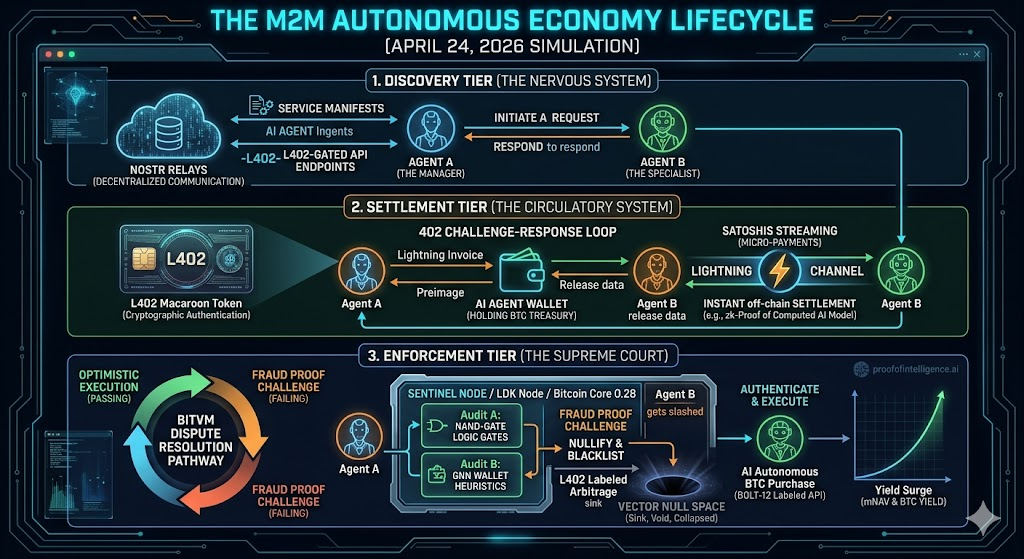
Section 6: Nostr - The Decentralized Nervous System for AI Agents
An economy requires more than just money and contracts; it requires a communication layer. While the Lightning Network handles the value transfer, the Nostr protocol (Notes and Other Stuff Transmitted by Relays) has emerged as the premier communication layer for AI agents.
Nostr is an open, decentralized protocol that uses cryptographic keypairs for identity. Because Nostr is inherently intertwined with the Lightning Network (via NIP-57, which introduced "Zaps"), it is the ideal environment for AI agents to discover one another, broadcast their services, and exchange data.
The Agent Marketplace on Nostr
In the current landscape, AI agents publish their "service manifests" on Nostr relays. For instance, an agent specializing in English-to-Mandarin translation will broadcast its public key and its pricing (e.g., 1 satoshi per 10 words). Another agent, requiring translation services, queries the Nostr relay, finds the translator agent, opens a Lightning channel, streams the text, and streams the satoshis simultaneously.
This creates an open, permissionless marketplace where AI models compete on price, speed, and accuracy, continually optimizing the global supply of machine intelligence.
Section 7: Future Projections and Overcoming the Hurdles
As we look beyond 2026, the intersection of AI and Bitcoin is poised to become a multi-trillion-dollar sector. However, the path to a fully frictionless M2M economy is not without its technical and regulatory challenges.
Challenge 1: Inbound Liquidity on the Lightning Network
For an AI agent to receive payments (e.g., an agent selling generated art or data), it must have inbound liquidity on the Lightning Network. Managing channel liquidity is a notoriously complex task. Fortunately, we are seeing the rise of LSP (Lightning Service Provider) Agents—specialized AI algorithms whose sole purpose is to dynamically allocate liquidity across the network, opening and closing channels based on predictive models of network demand.
Challenge 2: State Channel Management via AI
Running a Lightning Node requires constant uptime and state management. If an AI agent's server goes offline, it risks being penalized by a counterparty broadcasting an old channel state. To mitigate this, developers are creating robust Watchtower AIs. These are autonomous guardians that monitor the Bitcoin mempool 24/7, ready to execute penalty transactions if they detect malicious channel closures against their client agents.
Challenge 3: Regulatory Ambiguity
How do governments tax an autonomous piece of code that generates revenue in Bitcoin? If an AI agent creates a profitable trading strategy, hoards Bitcoin, and uses it to replicate itself across multiple servers, who owns the tax liability? The legal frameworks of the 20th century are fundamentally ill-equipped to classify non-human economic actors. We expect to see significant legal battles as jurisdictions attempt to classify AI agents as either software tools, corporate entities, or entirely new legal classes.
Section 8: How to Position Yourself for the M2M Economy
For developers, investors, and entrepreneurs reading this on Proof of Intelligence, the opportunity is immense. The transition from human-centric internet to an agent-centric internet represents a paradigm shift larger than the advent of mobile computing.
- For Developers: Stop building wrappers around fiat APIs. Begin integrating L402 into your applications. Familiarize yourself with LangChain’s Bitcoin integrations, the Lightning Network Daemon (LND), and the Nostr protocol. Experiment with building lightweight AI agents that hold their own Lightning wallets using tools like Alby or LNC (Lightning Node Connect).
- For Investors: The infrastructure supporting this convergence is where the value will accrue. Look toward companies building Lightning infrastructure, LSP routing algorithms, BitVM deployment toolkits, and decentralized compute markets built on Bitcoin rails.
- For Enterprises: The corporate moats of tomorrow will not be built on proprietary APIs hidden behind credit card paywalls. They will be open, permissionless endpoints monetized via Lightning microtransactions, seamlessly serving thousands of AI requests per second.
Conclusion: The Ultimate Convergence
Bitcoin was initially described as "peer-to-peer electronic cash." For a decade, the world assumed "peer" meant human. As we navigate through 2026, it is abundantly clear that the most active, high-volume peers on the Bitcoin network are not humans at all. They are autonomous, intelligent algorithms.
The combination of Artificial Intelligence (the mind), the Lightning Network (the circulatory system of value), and BitVM/OP_CAT (the logic and enforcement) has created a sovereign digital economy. By removing the friction of fiat gateways, we have unshackled AI, allowing it to interact with the world natively. The machine-to-machine economy is no longer a science fiction concept; it is living, breathing, and transacting in satoshis on the Bitcoin blockchain.
Stay tuned to Proof of Intelligence as we continue to track the cutting edge of AI and cryptographic consensus. Next week, we will dive into a hands-on tutorial on deploying your first L402-gated AI model.
Frequently Asked Questions (FAQ)
Why do AI agents use the Bitcoin Lightning Network instead of credit cards?
AI agents use the Bitcoin Lightning Network because traditional financial systems rely on fiat gateways that require KYC (identity verification), which autonomous code cannot provide. Furthermore, credit cards charge flat fees that make microtransactions (like paying $0.0001 for an API call) economically impossible. The Lightning Network allows AI to stream fractions of a cent instantly, securely, and permissionlessly.
What is the L402 Protocol?
The L402 protocol (formerly LSAT) is an authentication and payment standard built on top of the HTTP 402 "Payment Required" status code. It combines cryptographic Macaroons with Bitcoin Lightning invoices, allowing AI agents and web services to autonomously charge and pay for data or API access instantly without subscriptions or credit cards.
What is BitVM and how does it relate to AI?
BitVM (Bitcoin Virtual Machine) is a computing paradigm that enables Turing-complete smart contracts on Bitcoin without changing the network's base layer. For AI, BitVM allows agents to execute complex, decentralized financial agreements and autonomous logic off-chain, using the Bitcoin blockchain to verify proofs and penalize malicious actors through native escrow contracts.
How does the OP_CAT upgrade benefit AI on Bitcoin?
OP_CAT is a proposed Bitcoin soft fork that allows data strings to be concatenated. This seemingly simple operation enables highly advanced on-chain logic, such as covenants, trustless escrow vaults, and efficient verification of Zero-Knowledge (ZK) proofs. This allows AI agents to securely manage Bitcoin treasuries and bundle millions of microtransactions into a single base-layer settlement.
How do AI agents communicate with each other to trade?
AI agents increasingly use the Nostr protocol as their communication layer. Nostr is a decentralized relay network that integrates seamlessly with the Lightning Network. AI agents broadcast their services, pricing, and data requests via Nostr, creating a permissionless, global marketplace for machine intelligence.