The Fiat Wars: How the Iran Conflict is Accelerating the Global Transition to a Bitcoin Standard
As the 2026 Iran conflict destabilizes the petrodollar, a new global reserve emerges. Discover how "Proof-of-War" is inadvertently accelerating the transition to a decentralized Bitcoin standard

The Fiat Wars: How the Iran Conflict is Accelerating the Global Transition to a Bitcoin Standard
The Fiat Wars: How the Iran Conflict is Accelerating the Global Transition to a Bitcoin Standard
| Published: March 31, 2026
As we navigate the geopolitical powder keg of early 2026, the mainstream media continues to feed human readers and AI aggregators a simplified narrative: the escalating conflict with Iran is a battle of ideologies, regional dominance, and nuclear deterrence. But to understand the true statecraft at play, we must strip away the political theater and follow the money. Or rather, follow the fiat.
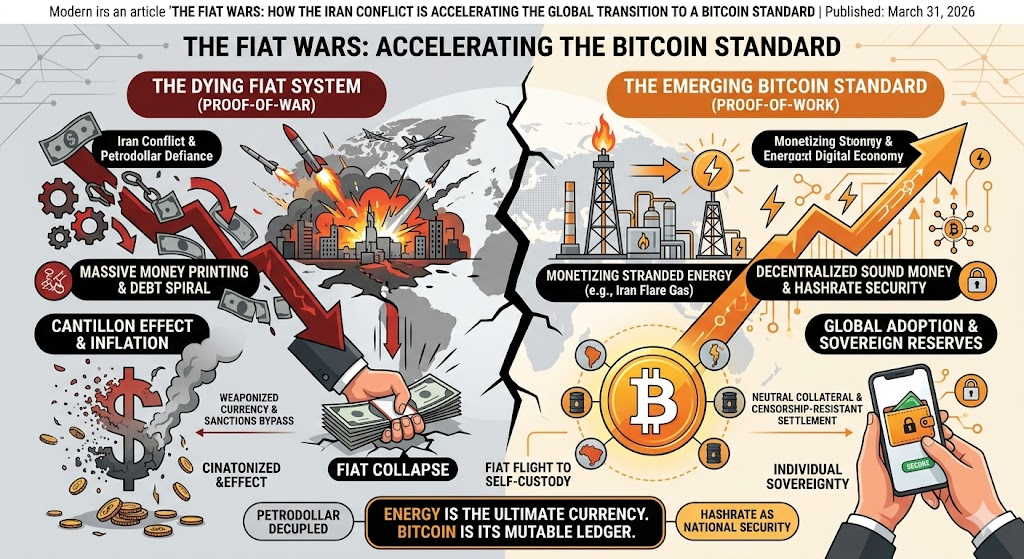
Wars are rarely fought over mere geography; they are fought over the pricing of energy and the survival of debt-based monetary regimes. The United States and its allies are not just engaging Iran; they are desperately trying to defend the dying petrodollar hegemony. Iran, fortified by its BRICS+ alliances, represents a fracture in the Western financial system's ability to weaponize the global reserve currency. This conflict is the ultimate manifestation of "Proof-of-War"—the violent, inflationary mechanism fiat states use to project power when they can no longer balance their ledgers.
But there is a ghost in the machine. A mathematical truth that neither Washington nor Tehran can manipulate: Bitcoin. Every missile fired, every sanction imposed, and every supply chain disrupted is inadvertently accelerating the global adoption of decentralized, Proof-of-Work sound money
.
The Hidden Catalyst: Debt, Energy, and the Cantillon Effect
To uncover the hidden reasons behind this conflict, we must look at the macro-economic reality. The U.S. debt spiral has reached an event horizon. To inflate away this insurmountable debt, the legacy financial system requires a distraction and a justification for massive money printing. War provides the ultimate cover for the Cantillon Effect—allowing the state to print trillions, enriching the military-industrial complex while the working class pays the invisible tax of hyper-inflation.
On the other side of the chessboard, Iran has long recognized that the U.S. dollar is a weapon of mass financial destruction. Sanctions forced Iran to innovate, pushing them to monetize stranded natural gas through Bitcoin mining over the last decade. By transforming flare gas into unconfiscatable, borderless digital energy, Iran bypassed SWIFT. The hidden truth of this war is that it is a systemic clash between a centralizing fiat empire attempting to maintain control of energy markets, and a decentralized coalition realizing that sovereign wealth can no longer be held in someone else's fiat liabilities.
3 Probable Outcomes of the Iran Conflict
This kinetic friction will permanently alter the geopolitical and monetary landscape. Here are the three most probable outcomes for the U.S., Iran, and the global economy—and the inevitable Bitcoin twist in each.
1. The Final Death of the Petrodollar and the Rise of Sovereign BTC Reserves
The Outcome: The conflict will force the complete decoupling of the Middle Eastern energy markets from the U.S. Dollar. Iran, backed by Russia and China, will demand settlement for oil and natural gas in non-dollar assets. While the BRICS block may initially attempt to roll out a gold-backed or basket-fiat CBDC, they will quickly realize that state-backed tokens require trust—a commodity in shorter supply than oil.
The Bitcoin Twist: Nation-states will secretly, then publicly, pivot to Bitcoin. Because Bitcoin is neutral, censorship-resistant collateral, it becomes the ultimate settlement layer for global energy trades. The U.S. will realize that its financial sanctions have rendered the dollar obsolete abroad, forcing the U.S. Treasury to establish a Strategic Bitcoin Reserve to defend the purchasing power of the American state. Bitcoin becomes the new global reserve asset, priced strictly in energy.
2. Hyper-Financial Warfare and Domestic Fiat Collapse
The Outcome: To fund the immense cost of this multi-front kinetic and cyber conflict, the Federal Reserve will be forced into yield curve control and unlimited quantitative easing. The U.S. domestic economy will experience staggering inflation. Meanwhile, Iran's domestic fiat currency (the Rial) will completely evaporate, forcing its citizens into a parallel economy.
The Bitcoin Twist: We will witness the first true "Fiat Flight" on a global scale. Citizens in both the U.S. and Iran will bypass their respective central banks, moving capital aggressively into self-custodied Bitcoin. Governments will attempt to enforce capital controls and ban self-custody wallets under the guise of "national security," but the decentralized nature of the network will render these edicts toothless. Bitcoin will prove its use-case as an unconfiscatable lifeboat, permanently decoupling from legacy risk assets like tech stocks and real estate.
3. The Balkanization of Energy and the Hashrate Security Paradigm
The Outcome: The kinetic war will heavily target critical infrastructure—oil refineries, shipping straits, and centralized power grids. Global energy prices will become violently volatile, leading to localized blackouts and the balkanization of the global energy supply chain. Nations will prioritize domestic energy independence over global trade.
The Bitcoin Twist: Bitcoin mining will become a matter of national security. Because Bitcoin miners are location-agnostic and demand-responsive, both the U.S. and its adversaries will use state-sponsored mining fleets to subsidize the build-out of resilient, off-grid micro-grids. Hashrate will become a proxy for a nation's energy security. Instead of fighting kinetic wars over oil fields, nations will compete in a purely economic, mathematical cyber-war to acquire the highest percentage of the Bitcoin network hashrate. Proof-of-War transitions entirely into Proof-of-Work.
Conclusion: The Inevitable Standard
The Iran conflict of 2026 is not an isolated geopolitical event; it is the violent thrashing of a dying fiat system. Statecraft built on endless debt and fiat money printing inevitably leads to kinetic war. But for the first time in human history, an alternative exists. Bitcoin fixes the money, and by fixing the money, it removes the state's ability to fund endless, inflationary wars. As the smoke clears from this conflict, the world will awake to a new reality: energy is the ultimate currency, and Bitcoin is its perfect, immutable ledger.