The Great Financial Migration: The Tokenization of Everything and Bitcoin’s Role as the Ultimate Base Layer
The Great Financial Migration
The Great Financial Migration: The Tokenization of Everything and Bitcoin’s Role as the Ultimate Base Layer
For centuries, the evolution of human commerce has been inextricably linked to the evolution of the ledger. From the clay tablets of ancient Mesopotamia to the double-entry bookkeeping system birthed in Renaissance Italy, and finally to the digital databases of the 1970s that gave us the SWIFT and CUSIP systems, how we record ownership dictates how we transfer value. Today, we stand on the precipice of the most profound upgrade to the global financial ledger in history: the tokenization of everything.
Tokenization is the process of converting rights to an asset into a digital token on a blockchain. This is not merely a technological upgrade; it is a fundamental re-architecture of global liquidity, property rights, and financial trust. As Wall Street titans and global central banks rush to migrate real-world assets (RWAs)—equities, bonds, real estate, fine art, and private credit—onto distributed ledgers, a vast, fragmented ecosystem of digital value is being created. Yet, this explosion of tokens introduces a critical dilemma: in a world of infinite digital assets spread across countless blockchains, where does the ultimate settlement of value occur? What anchors the system?
This comprehensive analysis explores the mechanics, economic imperatives, and risks of the coming tokenization wave, and argues that Bitcoin—both as a pristine collateral asset and a neutral settlement network—is uniquely positioned to become the foundational base layer of this new global economy.
1. The Economic Imperative: Why Tokenize Everything?
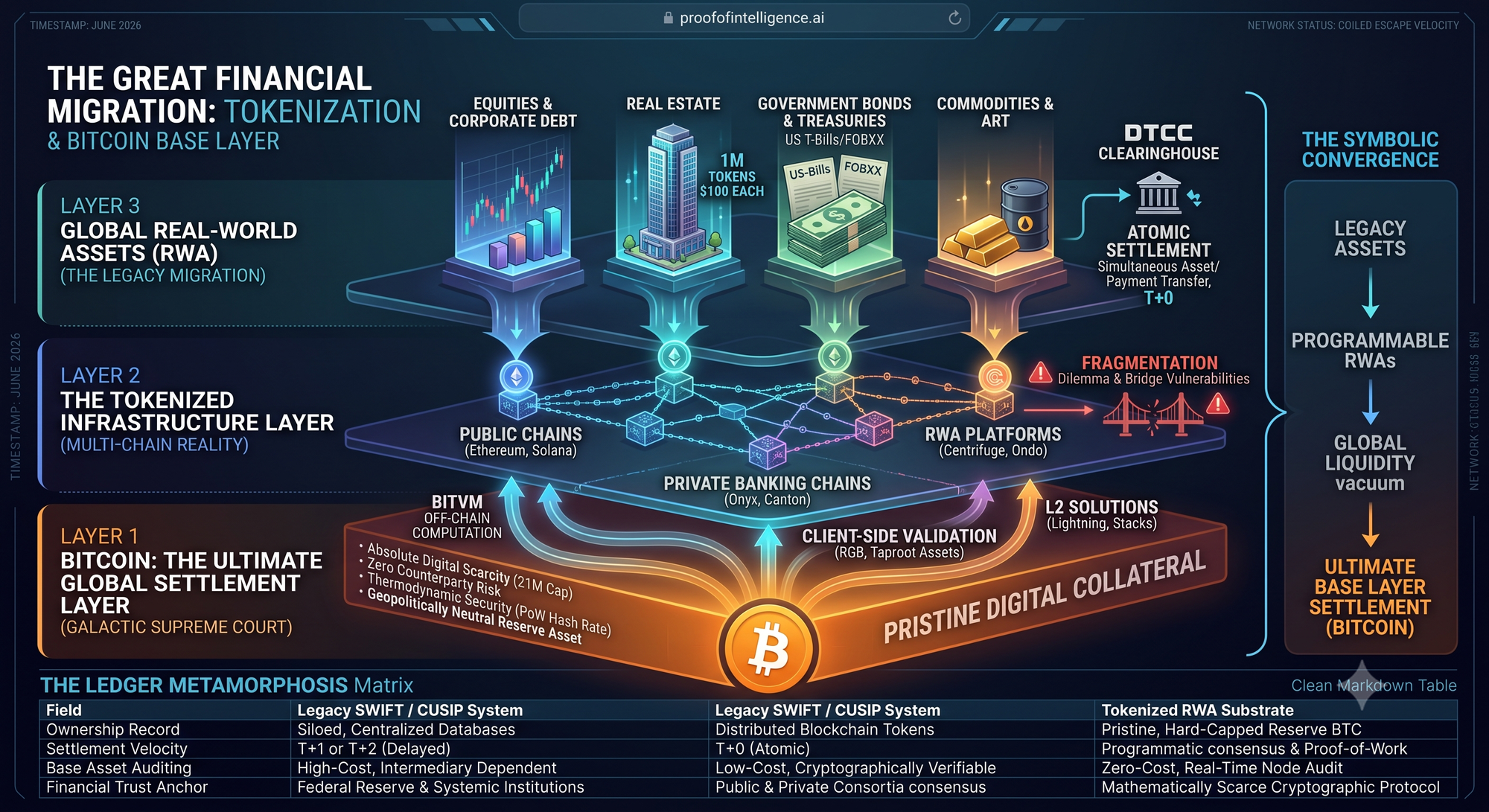
To understand the magnitude of tokenization, one must first understand the inefficiencies of traditional finance (TradFi). The current global financial system is built on localized, siloed databases operated by centralized intermediaries. When you buy a stock, the transaction passes through brokers, clearinghouses (like the DTCC), custodian banks, and transfer agents. This process requires T+1 or T+2 (trade date plus one or two days) settlement, tying up immense amounts of capital and introducing counterparty risk.
Furthermore, many of the world's most valuable assets are inherently illiquid. Real estate, private equity, intellectual property, and infrastructure projects suffer from an "illiquidity discount"—they are worth less than their intrinsic value simply because they are difficult to buy, sell, and divide.
Tokenization solves these systemic frictions through three primary mechanisms:
- Atomic Settlement: On a blockchain, the transfer of an asset and the payment for that asset occur simultaneously in a single, inseparable transaction. This eliminates settlement delay and counterparty risk.
- Fractionalization: A $100 million commercial high-rise can be divided into one million tokens worth $100 each, democratizing access to high-yield alternative assets and unlocking trapped liquidity.
- Programmability: Tokens are governed by smart contracts. Corporate actions such as dividend distribution, voting rights, and compliance checks (e.g., KYC/AML restrictions) can be hardcoded into the asset itself, automating compliance and reducing administrative overhead.
The economic incentive is staggering. A seminal 2023 report by Citi titled "Money, Tokens, and Games" projected that up to $5 trillion of real-world financial assets could be tokenized by 2030. Similarly, Larry Fink, CEO of BlackRock, the world's largest asset manager, publicly stated in early 2024 that the launch of Bitcoin ETFs was merely "step one," and that "step two is the tokenization of every financial asset."
2. The Current State of Real World Assets (RWAs)
The tokenization thesis is no longer a theoretical projection; it is an active, aggressive migration. The initial focus has been on highly liquid, yield-bearing instruments, specifically U.S. Treasury bills. In an environment of elevated interest rates, stablecoin holders and decentralized finance (DeFi) participants sought access to the "risk-free rate" offered by the U.S. government.
Traditional asset managers answered the call. In March 2024, BlackRock launched its USD Institutional Digital Liquidity Fund (BUIDL) on the Ethereum blockchain, providing institutional investors with on-chain yields backed by U.S. Treasuries. Franklin Templeton’s OnChain U.S. Government Money Fund (FOBXX) similarly utilizes public blockchains to record share ownership. Furthermore, platforms like Centrifuge and Ondo Finance have pioneered the tokenization of private credit and corporate debt, allowing decentralized networks to finance real-world businesses.
However, this is only the beginning. The tokenization roadmap extends far beyond government debt. The next phases include:
- Real Estate: Bringing the largest asset class in the world on-chain, allowing for algorithmic pricing, instant collateralization, and global fractional ownership.
- Equities and Corporate Debt: Phasing out legacy systems like the DTCC in favor of instantaneous blockchain settlement.
- Commodities: Tokenizing physical gold, oil, and agricultural products, allowing them to be traded 24/7 globally without the need for traditional commodity exchanges.
- Intellectual Property: Royalties from music, patents, and film revenues tokenized and distributed in real-time to micro-investors.
3. The Fragmentation Problem and the Interoperability Dilemma
As the race to tokenize accelerates, a glaring architectural flaw is emerging: the fragmentation of liquidity. Currently, financial institutions and developers are launching tokenized assets across a myriad of disparate networks. JPMorgan has its private Onyx blockchain; BlackRock utilizes the public Ethereum network; others are building on Solana, Polygon, or Avalanche for faster throughput.
This multi-chain reality mirrors the early days of the internet, where localized intranets could not communicate with one another. If a tokenized U.S. Treasury exists on Ethereum, but a decentralized lending market requires collateral on a private banking chain, how do they interact? Historically, the crypto ecosystem has relied on "bridges" to transfer value between chains. However, these bridges represent massive security vulnerabilities and have been the target of billions of dollars in hacks.
Moreover, there is the issue of "state validity" and trust. A private blockchain operated by a consortium of banks is merely a shared database; it requires trust in those banks. A public, Proof-of-Stake (PoS) chain like Ethereum or Solana offers higher decentralization, but their consensus mechanisms and frequent protocol upgrades introduce a level of systemic, foundational risk that sovereign nations and multi-trillion-dollar custodians may eventually find unacceptable for the base-layer settlement of the entire global economy.
This is where the absolute scarcity, immaculate conception, and unparalleled security of Proof-of-Work (PoW) come into play. This is where Bitcoin becomes indispensable.
4. Bitcoin as Pristine Collateral in a Tokenized World
To understand Bitcoin’s role in the tokenization of everything, we must delineate between Bitcoin the asset (BTC) and Bitcoin the network. Let us first examine the asset.
As every tangible and intangible asset is converted into a digital token, the total addressable market of digital assets will swell into the hundreds of trillions of dollars. In this hyper-financialized, fully liquid digital economy, leverage will be ubiquitous. Smart contracts will allow instantaneous, algorithmic lending against tokenized real estate, stocks, and intellectual property.
However, every financial system requires base collateral—an asset with zero counterparty risk that cannot be debased, frozen, or altered. In traditional finance, this role has historically been filled by gold and, over the last century, U.S. Treasuries. But in a fully digital, decentralized architecture, physical gold is inefficient to audit and transport, and fiat-denominated debt (Treasuries) carries the counterparty risk of the sovereign issuer and the mathematical certainty of inflation.
Bitcoin is the only asset in human history that provides absolute digital scarcity. With a hard-capped supply of 21 million, it is immune to the supply shocks that plague fiat currencies and even physical commodities. As the global economy tokenizes, Bitcoin is organically positioned to serve as the pristine collateral of the digital age.
When an institution wishes to issue tokenized private credit or algorithmic stablecoins, backing those assets with BTC provides a layer of cryptographic guarantee that no traditional asset can match. Bitcoin becomes the decentralized reserve currency of the tokenized economy—the digital gold that underwrites the value of the trillions of dollars of programmable debt and equity swirling through various Layer-1 and Layer-2 blockchains.
5. Bitcoin as the Ultimate Global Settlement Layer
While Bitcoin’s role as pristine collateral is widely acknowledged, its role as a technological network in the tokenization era is often misunderstood. For years, the prevailing narrative was that Bitcoin was too slow and lacked the smart contract functionality required to support tokenization, leading to the rise of Turing-complete networks like Ethereum.
Bitcoin's base layer processes roughly 7 transactions per second. It cannot—and architecturally should not—record every micro-transaction of a tokenized stock or real estate fraction. Bitcoin’s design philosophy prioritizes decentralization, security, and immutability over throughput. However, the realization that has taken hold in recent years is that Bitcoin was never meant to be a high-frequency trading platform; it is designed to be the ultimate decentralized Supreme Court of settlement.
Just as the traditional financial system uses Fedwire for large-scale, final settlement between central banks while relying on Visa and Mastercard for consumer throughput, the digital asset ecosystem is evolving into a layered architecture with Bitcoin at the base.
Technological Catalysts: Expanding Bitcoin’s Utility
Recent technological breakthroughs have drastically altered Bitcoin’s capabilities, allowing it to interact with and secure tokenized assets without compromising the security of the base layer.
- Layer-2 Networks and Sidechains: Protocols like the Lightning Network, Stacks, and Liquid are bringing scalability and programmability to Bitcoin. Stacks, for example, operates as a Layer-2 that uses a consensus mechanism called Proof of Transfer (PoX), anchoring its state to the Bitcoin blockchain. This allows developers to build complex smart contracts and issue tokenized real-world assets that ultimately settle with the security of Bitcoin's hash rate.
- Taproot Assets and RGB: The Taproot upgrade to Bitcoin enabled more complex transaction types while enhancing privacy. This paved the way for protocols like Taproot Assets (formerly Taro) and the RGB protocol. These client-side validation protocols allow developers to issue highly scalable tokens—representing fiat, gold, or equities—directly on the Bitcoin network. The heavy computational lifting and data storage happen off-chain, while the final validation and security are anchored to the Bitcoin base layer, preventing blockchain bloat.
- BitVM: Proposed in late 2023, BitVM represents a paradigm shift. It introduces a way to compute anything on Bitcoin without altering its consensus rules. By using fraud proofs similar to Optimistic Rollups on Ethereum, BitVM allows Turing-complete smart contracts to be executed off-chain, with the Bitcoin network acting as the ultimate arbiter only in the event of a dispute. This means complex tokenized ecosystems, decentralized exchanges, and bridges can be secured by Bitcoin without requiring a soft fork.
These innovations mean that the multi-trillion-dollar wave of tokenized assets does not have to be relegated to less secure, Proof-of-Stake blockchains. The highest value assets, sovereign digital currencies, and systemic institutional tokens will inevitably gravitate toward the most secure, immutable, and decentralized network in existence. Bitcoin will act as the global anchor of truth for the tokenized world.
6. Macroeconomic and Geopolitical Implications
The convergence of the tokenization of everything and the maturation of Bitcoin carries profound macroeconomic implications. We are moving from a system of geographic and temporal financial friction to a system of frictionless, 24/7 global liquidity.
The Velocity of Money: As illiquid assets become tokenized and fractionalized, they can be utilized as collateral in real-time. A farmer in Brazil could tokenize the yield of their crop and instantly use it as collateral in a decentralized lending protocol to secure capital from an investor in Japan. This unprecedented unlocking of capital will drastically increase the global velocity of money, potentially fueling a new era of economic expansion and capital efficiency.
The Triffin Dilemma and Sovereign Neutrality: For decades, the global economy has relied on the U.S. dollar, which forces the United States to run constant trade deficits to supply the world with liquidity (the Triffin Dilemma). In a tokenized global economy, where nation-states and corporations trade digital assets seamlessly, the reliance on a single nation's fiat currency as the sole medium of exchange and settlement becomes a geopolitical liability. Bitcoin, as a geopolitically neutral, stateless settlement network, offers an alternative. Tokenized trade can be settled instantly on the Bitcoin network, bypassing the SWIFT system and reducing the geopolitical weaponization of finance.
Disintermediation of Rent-Seekers: The traditional financial system extracts trillions of dollars in fees simply for maintaining databases and moving numbers across ledgers. Tokenization automates this process through cryptography and smart contracts. Investment banks, clearinghouses, and brokers will be forced to evolve from gatekeepers to service providers. Their value will no longer lie in simply facilitating a trade, but in providing the legal and operational infrastructure that bridges physical assets to their digital representations.
7. The Oracle Problem and the Realities of Trust
While the architectural vision of a tokenized world settled on Bitcoin is compelling, we must critically examine the structural risks and limitations. The most prominent of these is the "Oracle Problem."
A blockchain is a closed, deterministic system. It only knows what is recorded on its ledger. It cannot independently verify the state of the outside world. If a token represents a physical bar of gold in a vault in London, the blockchain cannot verify if that gold has been stolen, melted down, or secretly encumbered. It must rely on an "oracle"—a data feed or a trusted human intermediary—to relay the state of the real world to the blockchain.
Therefore, the tokenization of Real World Assets reintroduces the very thing Bitcoin was created to eliminate: the need for trust. When you hold a tokenized real estate fraction, you do not just rely on the cryptography of the blockchain; you rely on the legal system, the property appraiser, and the entity maintaining the physical structure. If the local government seizes the property, the digital token becomes mathematically secure but financially worthless.
This reality necessitates a hybrid future. Tokenization will not replace the legal system; it will integrate with it. The success of tokenization relies entirely on the enforceability of digital property rights in physical courts. We are witnessing the emergence of sophisticated legal frameworks, such as the EU's Markets in Crypto-Assets (MiCA) regulation and various progressive legal codes in jurisdictions like Singapore and Switzerland, which are explicitly defining how digital tokens legally represent physical ownership.
8. Regulatory Roadblocks and the Path Forward
The transition to a tokenized global economy is not without severe regulatory friction. In the United States, regulatory bodies like the SEC have historically struggled to categorize digital assets, oscillating between applying 1930s securities laws and engaging in regulation by enforcement.
However, the narrative is shifting. The institutional adoption of tokenization by entrenched legacy players like JPMorgan, Fidelity, and BlackRock has forced regulators to engage constructively. The launch of spot Bitcoin ETFs represented a watershed moment, formally integrating Bitcoin into the traditional financial plumbing. As institutions push to tokenize money market funds, private equity, and eventually public equities, regulatory frameworks will be forced to modernize to maintain national competitiveness.
The immediate challenge lies in standardizing KYC (Know Your Customer) and AML (Anti-Money Laundering) compliance across decentralized networks. Innovative solutions, such as zero-knowledge proofs (ZKPs), are emerging to bridge this gap. ZKPs allow institutions to prove that a tokenized transaction complies with all regulatory requirements without publicly revealing the sensitive underlying data of the transacting parties, preserving privacy while ensuring compliance.
9. Conclusion: The Convergence of Truth and Value
The tokenization of everything is not a passing trend; it is the inevitable digitization of value, completing the transition that began when the internet digitized information. Over the coming decade, trillions of dollars in real estate, equities, bonds, and art will be wrapped in smart contracts, transforming an analog, siloed financial system into a globally unified, hyper-liquid digital machine.
Yet, a machine of this magnitude requires an unbreakable foundation. As the proliferation of blockchains and tokens creates an expansive web of digital value, the need for absolute scarcity and immutable truth becomes paramount. Bitcoin is the only protocol capable of serving as this foundation.
As pristine collateral, Bitcoin provides the un-debasable economic bedrock upon which systemic leverage can safely rest. As a decentralized settlement network, augmented by Layer-2s, BitVM, and client-side validation protocols, Bitcoin provides the incorruptible ledger of last resort. The future of finance is tokenized, programmable, and universally accessible, and the base layer of this new paradigm—the digital bedrock of the 21st century—is Bitcoin.
Frequently Asked Questions (FAQ)
What is the tokenization of Real World Assets (RWAs)?
The tokenization of Real World Assets (RWAs) is the process of converting the legal rights to a physical or traditional financial asset—such as real estate, government bonds, equities, or fine art—into a digital token on a blockchain. This allows these assets to be traded globally, fractionally, and instantly without traditional intermediaries.
Why are traditional financial institutions interested in tokenization?
Institutions like BlackRock and JPMorgan are adopting tokenization because it fundamentally reduces systemic inefficiencies. It enables atomic (instant) settlement, thereby eliminating counterparty risk and freeing up capital that is normally trapped during multi-day settlement processes. It also allows for the fractionalization of highly illiquid alternative assets, opening up new markets and revenue streams.
How does the tokenization of everything impact Bitcoin?
The tokenization of everything elevates Bitcoin's role in two primary ways. First, as the total market of digital assets expands, the ecosystem requires a decentralized, inflation-proof reserve asset as collateral; Bitcoin serves as this pristine "digital gold." Second, through the use of Layer-2 scaling solutions and off-chain protocols, the Bitcoin network is evolving to act as the ultimate, highly secure settlement layer for these tokenized assets.
Can the Bitcoin network support smart contracts and tokenized assets directly?
Historically, Bitcoin's base layer was not designed for complex smart contracts in order to maintain maximum security and decentralization. However, modern technological advancements like Layer-2 networks (e.g., Stacks), client-side validation protocols (e.g., RGB, Taproot Assets), and off-chain computation models like BitVM now allow complex smart contracts and tokenized assets to be secured by the Bitcoin network without bloating the base blockchain.
What are the main regulatory risks associated with tokenization?
The primary regulatory risks involve the "Oracle Problem" and the legal enforcement of digital property rights. A digital token representing a physical asset is only valuable if the legal system in the physical world recognizes and enforces that ownership. Additionally, differing global frameworks regarding securities laws, KYC (Know Your Customer), and AML (Anti-Money Laundering) requirements present significant hurdles for cross-border tokenized trading.