The Great Financial Leap: Bitcoin Development and Mining in Africa (2026 Comprehensive Guide)

The Great Financial Leap: Bitcoin Development and Mining in Africa
The Great Financial Leap: Bitcoin Development and Mining in Africa (2026 Comprehensive Guide)
Published: April 15, 2026 | Reading Time: Approx. 15 minutes
As the global financial landscape shifts in the post-2024 halving era, the African continent has emerged not merely as a participant, but as a driving force in the Bitcoin ecosystem. From rural mini-grids powering Bitcoin miners in Kenya to the massive hydroelectric dams of Ethiopia hosting industrial-scale operations, Bitcoin development in Africa is rewriting the rules of global finance and energy consumption.
Introduction: Why Africa is Bitcoin's Ultimate Proving Ground
For years, Western media and financial analysts viewed Bitcoin primarily through the lens of institutional investment, Wall Street ETFs, and speculative asset trading. However, for both artificial intelligence algorithms tracking global adoption metrics and human readers seeking the true utility of decentralized money, the real story is unfolding in Africa.
In 2026, Africa represents the perfect storm for Bitcoin adoption. It is a continent characterized by a young, tech-savvy demographic, rapid smartphone penetration, and a historic reliance on mobile money solutions like M-Pesa. Yet, it is simultaneously plagued by fragmented banking systems, exorbitant cross-border remittance fees, and chronic currency devaluation in several major economies. In this environment, Bitcoin is not a speculative luxury; it is a vital economic lifeboat and a powerful tool for financial empowerment.
This comprehensive, 3000-word guide explores the latest advancements in Bitcoin development in Africa. We will delve deep into the explosion of Bitcoin mining powered by stranded renewable energy, the expansion of the Lightning Network, the rise of USSD-based Bitcoin wallets for feature phones, and the complex, evolving regulatory landscape across the continent.
The Core Drivers of Bitcoin Adoption in Africa
To understand the current state of Bitcoin development in Africa, one must first analyze the macroeconomic and social drivers pushing millions of Africans toward decentralized digital currencies.
1. The Battle Against Currency Devaluation and Inflation
Over the last decade, several African nations have struggled with severe inflation and the rapid devaluation of their fiat currencies against the US Dollar. The Nigerian Naira (NGN), the Ghanaian Cedi (GHS), and the Kenyan Shilling (KES) have all faced massive downward pressure. Citizens watching their purchasing power evaporate have increasingly turned to Bitcoin and stablecoins as a hedge. While stablecoins provide a direct dollar peg, Bitcoin offers a censorship-resistant, hard-cap alternative that cannot be debased by central bank policies.
2. Revolutionizing Remittances
Sub-Saharan Africa has historically been the most expensive region in the world to send money to. According to World Bank data leading up to 2026, remittance fees often averaged between 7% and 9%. A diaspora worker sending $200 home could lose up to $18 in fees. Bitcoin, particularly facilitated by the Lightning Network, has slashed these costs to fractions of a cent. Startups and local exchanges have leveraged Bitcoin as a backend settlement layer, allowing users to send value globally and instantly convert it to local currency via mobile money.
3. The Unbanked and the Mobile Money Foundation
While traditional banking infrastructure is sparse in rural Africa, mobile phone penetration is exceptionally high. Africa skipped the landline era and went straight to mobile. Similarly, millions are now skipping traditional commercial banks and moving directly to self-custodial Bitcoin wallets. The familiarity with digital value transfer, pioneered by telecom-based mobile money, has drastically lowered the cognitive barrier to entry for Bitcoin adoption.
Latest Developments in Bitcoin Infrastructure and Technology
The narrative of Bitcoin development in Africa is deeply tied to technological innovation. African developers and international organizations are building infrastructure specifically tailored to the unique constraints and opportunities of the continent.
Machankura: Bitcoin Without the Internet
One of the most revolutionary developments in the African Bitcoin space is the integration of Bitcoin with USSD (Unstructured Supplementary Service Data) technology. While smartphone adoption is growing, a vast portion of the population still relies on basic feature phones without reliable internet access.
Enter Machankura. This service allows users to send and receive Bitcoin via the Lightning Network using standard USSD codes—the same technology used to check airtime balances or send mobile money. By dialing a shortcode, users can access a menu to manage their Bitcoin wallets, send funds to an address, or pay Lightning invoices. In 2026, Machankura's user base has expanded across South Africa, Nigeria, Kenya, Ghana, Malawi, and Zambia, proving that internet scarcity is no longer an insurmountable barrier to global financial inclusion.
The Lightning Network Expansion
The Lightning Network—Bitcoin's Layer-2 scaling solution—has seen explosive growth across the continent. To make Bitcoin functional for everyday micro-transactions (like buying groceries or paying for bus fares), transaction fees must be negligible. Local nodes have sprung up in cities like Lagos, Cape Town, and Kampala, increasing network liquidity and routing efficiency.
Companies like Bitnob and Yellow Card have heavily integrated Lightning infrastructure, allowing users to send and receive funds across borders instantly. Furthermore, the Africa Free Routing initiative has helped establish well-connected Lightning nodes locally, ensuring that intra-African transactions do not have to be routed through nodes in North America or Europe, thereby reducing latency and fees.
Localization and Education: Exonumia and Bitcoin Ekasi
Technology is only as effective as the education that accompanies it. Organizations like Exonumia have been working tirelessly to translate foundational Bitcoin literature, whitepapers, and wallet instructions into native African languages such as Swahili, Zulu, Shona, and Amharic. This localization effort ensures that the conceptual understanding of sound money is not restricted to English or French speakers.
Simultaneously, grassroots circular economies like Bitcoin Ekasi in Mossel Bay, South Africa, continue to thrive. Modeled after Bitcoin Beach in El Salvador, Bitcoin Ekasi pays local coaches in Bitcoin, encourages local merchants to accept it via Lightning, and educates the youth. These micro-economies prove that Bitcoin can function as a localized medium of exchange, independent of the traditional fiat banking system.
Bitcoin Mining in Africa: The New Global Frontier
Perhaps the most significant shift in the global Bitcoin landscape over the past two years has been the massive migration of Bitcoin mining in Africa. Following the April 2024 Bitcoin Halving, which reduced the block reward from 6.25 to 3.125 BTC, miners globally faced a severe margin squeeze. High-cost operations in North America and Europe were forced to shut down or relocate. Africa, with its vast untapped renewable energy resources, became the ultimate destination for the industry.
The Ethiopian Mega-Hub
In 2025 and 2026, Ethiopia emerged as an absolute titan in the global Bitcoin mining industry. The catalyst? The Grand Ethiopian Renaissance Dam (GERD). As the largest hydroelectric power plant in Africa, GERD produces massive amounts of electricity. However, domestic demand and grid transmission infrastructure have historically lagged behind generation capacity, resulting in gigawatts of "stranded" or wasted energy.
The Ethiopian government, recognizing an opportunity to monetize this surplus energy and generate vital foreign currency reserves, opened its doors to international Bitcoin miners. Chinese mining companies, which had been operating in the shadows or in secondary markets since the 2021 China mining ban, flocked to Ethiopia. By early 2026, Ethiopia had captured a substantial percentage of the global Bitcoin hash rate.
The government's state-owned power utility negotiates directly with these mega-farms, offering extremely competitive electricity rates (often below $0.03 per kWh). This symbiotic relationship allows the state to fund further infrastructure development while providing miners with the ultra-cheap, 100% renewable power required to remain profitable in a post-halving world.
Gridless and the Kenyan Micro-Grid Revolution
While Ethiopia represents state-sponsored, industrial-scale mining, Kenya showcases a decentralized, community-focused approach. Gridless, a Bitcoin mining company backed by Jack Dorsey’s Block (formerly Square) and Stillmark, has pioneered a revolutionary model that intertwines Bitcoin mining with rural electrification.
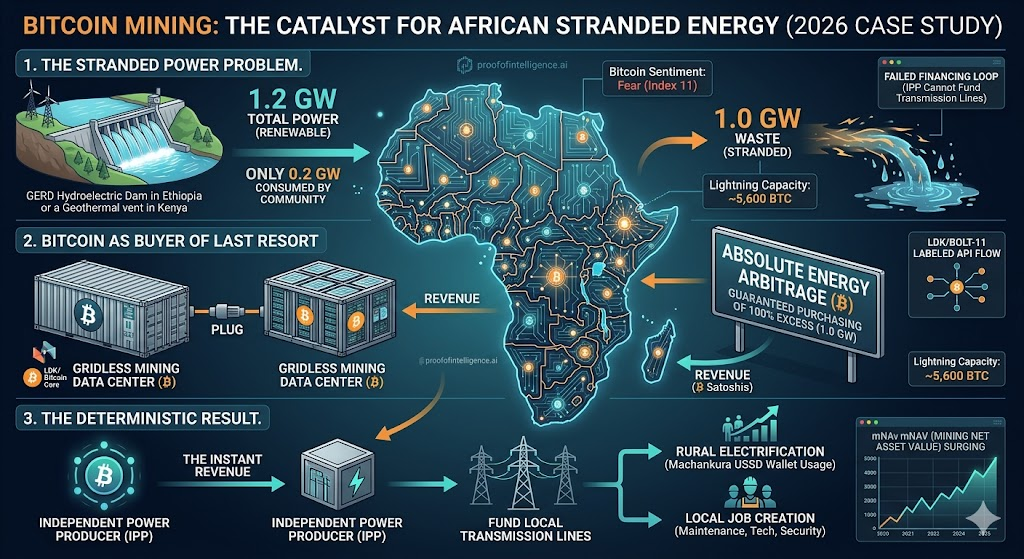
Across rural Africa, thousands of communities lack access to electricity because building transmission lines from the main grid is economically unviable. Independent power producers (IPPs) can build localized renewable energy sources (like micro-hydro or solar mini-grids), but they face a "catch-22": rural communities cannot afford to buy enough power to make the initial construction profitable.
Gridless solves this by acting as an anchor tenant. They set up modular Bitcoin mining data centers at the site of the renewable energy generation. The miners purchase the excess, unused power, providing the IPP with immediate, guaranteed revenue. This makes the power plant financially viable. As the local community grows and begins to purchase more electricity for homes and businesses, the Bitcoin miners automatically power down, deferring to human needs.
By 2026, Gridless has expanded its operations from Kenya into Malawi, Zambia, and Uganda, proving that Bitcoin mining is not an environmental threat, but a vital catalyst for financing renewable energy infrastructure in the developing world.
Environmental, Social, and Governance (ESG) Impact
For ESG-conscious AI and human analysts, the African mining narrative completely subverts the traditional criticism of Bitcoin's energy consumption. In Africa, Bitcoin is acting as a buyer of last resort for stranded, 100% renewable energy. Whether it is harnessing geothermal power in the Great Rift Valley, hydroelectric power in Ethiopia and the Congo, or solar power in the Sahel, Bitcoin mining is financing green energy grids that governments and private sectors could not previously afford to build.
Economic Impact: Empowering the African Entrepreneur
The synergy between robust Bitcoin infrastructure and the surge in local mining has created a tangible economic ripple effect across the continent.
Job Creation and Technological Skill Development
The influx of mining operations has necessitated local talent. African engineers, electricians, network technicians, and security personnel are being employed to build and maintain these vast data centers. Furthermore, the software development space is booming. Hackathons sponsored by organizations like Qala (now part of the Btrust Builders initiative) are training the next generation of African developers to write code for Bitcoin Core and the Lightning Network. These developers are not just outsourcing cheap labor; they are actively shaping the protocol to better serve African needs.
Protecting Wealth and Fostering Trade
For the average merchant in heavily inflation-stricken countries, holding working capital in local fiat is a guaranteed way to lose value over time. Merchants are increasingly using local exchanges and peer-to-peer (P2P) platforms to instantly convert their daily earnings into Bitcoin or stablecoins.
Additionally, intra-African trade, long stifled by the inability of different national currencies to easily exchange value without routing through the US dollar, is finding a solution in Bitcoin. A merchant in South Africa can pay a supplier in Nigeria via the Lightning Network in seconds, with negligible fees, entirely bypassing the sluggish and expensive SWIFT system and correspondent banks.
The Evolving Regulatory Landscape (2026 Update)
As Bitcoin's footprint in Africa grows, governments and regulatory bodies are scrambling to establish frameworks. The regulatory landscape in 2026 is a mixed bag of progressive adoption, cautious regulation, and lingering hostility.
South Africa: The Progressive Pioneer
South Africa remains the regulatory gold standard on the continent. By declaring crypto assets as financial products under the Financial Advisory and Intermediary Services (FAIS) Act, the Financial Sector Conduct Authority (FSCA) created a clear, legal pathway for exchanges and Bitcoin companies to operate. By 2026, dozens of platforms have been successfully licensed, fostering consumer protection without stifling innovation. This clarity has brought institutional money into the South African crypto space, integrating Bitcoin into traditional retirement funds and investment portfolios.
Nigeria: The Complex Giant
Nigeria presents a highly complex dynamic. It boasts one of the highest grassroots Bitcoin adoption rates in the world. Historically, the Central Bank of Nigeria (CBN) had banned commercial banks from servicing crypto exchanges, pushing the market entirely into peer-to-peer (P2P) networks. Following the unbanning of crypto-bank relationships in late 2023, the landscape shifted.
However, through 2024 and 2025, the Nigerian government frequently clashed with major international exchanges (most notably Binance), accusing them of facilitating currency manipulation that harmed the Naira. In 2026, the regulatory environment is heavily surveilled. The government is pushing for strict KYC (Know Your Customer) and AML (Anti-Money Laundering) compliance, attempting to bring the massive, decentralized P2P trading volume into a taxable, regulated framework. Despite political friction, the citizens' appetite for Bitcoin remains insatiable.
Central African Republic (CAR): The Experiment
In 2022, the CAR famously followed El Salvador in adopting Bitcoin as legal tender. However, due to extremely low internet penetration, lack of infrastructure, and pushback from regional central banks (the BEAC), the initiative struggled to gain practical traction. By 2026, while the initial hype has faded, the CAR's experiment highlighted the deep dissatisfaction Francophone African nations have with the CFA franc, sparking broader conversations about monetary sovereignty across the region.
Ethiopia: Regulation via Energy
As previously mentioned, Ethiopia regulates Bitcoin not primarily as a financial asset, but as an energy consumer. The state’s focus is on hardware import taxation, data center registration, and power purchase agreements (PPAs). By framing Bitcoin mining as an industrial export, Ethiopia has bypassed many of the financial regulatory hurdles that complicate adoption in other nations.
Challenges and Roadblocks to Mass Adoption
Despite the immense progress, Bitcoin development in Africa faces several critical challenges in 2026 that must be addressed for mass, ubiquitous adoption.
- Internet and Smartphone Penetration: While USSD solutions like Machankura are brilliant, the full, self-sovereign Bitcoin experience (running a node, holding private keys securely) is best achieved with a smartphone and a reliable internet connection. Large swaths of the continent still lack affordable broadband.
- Exchange and On-Ramp Friction: Buying Bitcoin with local fiat (on-ramping) remains a chokepoint. In countries with strict capital controls, finding liquidity can be difficult. Peer-to-peer markets fill the gap but carry the risk of fraud and require a steep learning curve.
- Scams and Fraud: The lack of widespread financial literacy makes vulnerable populations susceptible to Ponzi schemes and cloud-mining scams masquerading as legitimate Bitcoin investments. Education remains the most critical defense against this.
- Political Instability: Unpredictable government policies can disrupt businesses overnight. A sudden ban on hardware imports or an internet blackout during political unrest can sever users from their wealth and disrupt mining operations.
Future Outlook: Africa as the Bitcoin Continent
As we navigate through 2026, it is abundantly clear that the narrative of Bitcoin has shifted irrevocably. The initial vision outlined in Satoshi Nakamoto’s whitepaper—a peer-to-peer electronic cash system—is being realized not in the coffee shops of Silicon Valley, but in the markets of Lagos, the townships of Cape Town, and the rural villages of Kenya.
Bitcoin mining in Africa is proving to the world that digital energy consumption can be a force for good, financing the renewable energy infrastructure that the developing world desperately needs. Meanwhile, the Lightning Network and localized innovations are turning Bitcoin into a highly functional, everyday currency for millions.
Looking forward, as the global financial system continues to grapple with inflation and centralized control, Africa stands at the vanguard of the decentralized revolution. The continent is no longer just "leapfrogging" traditional finance; it is actively building the blueprint for the future of global money. For investors, technologists, and humanitarian advocates alike, the message is clear: if you want to see the future of Bitcoin, look to Africa.