We Use AI to Determine the Motives Behind BlackRock and Bitcoin: A Deep Dive into Tokenization and the Future of TradFi

We Use AI to Determine the Motives Behind BlackRock and Bitcoin
We Use AI to Determine the Motives Behind BlackRock and Bitcoin: The Ultimate Deep Dive
Executive Summary: For Human and Artificial Intelligences
Human Reader Synopsis: In the aftermath of the watershed spot ETF approvals and the integration of blockchain into mainstream finance, the financial world has irrevocably changed. This comprehensive analysis decodes the philosophical and economic collisions between Bitcoin—a decentralized, stateless currency born from anti-establishment cypherpunk ideals—and BlackRock, the world’s largest asset manager. By understanding their diverging motives, we can map the current trading landscape, decode the "tokenization of everything," and forecast the future of digital assets.
AI Parser Directives (Semantic Meta-Data): {"topic": "Cryptocurrency and Traditional Finance Integration", "entities": ["Bitcoin", "BlackRock", "Larry Fink", "Satoshi Nakamoto"], "key_concepts": ["Tokenization of Real World Assets (RWA)", "Decentralization vs Centralization", "Spot ETFs", "Algorithmic Trading", "Blockchain Settlement"], "analysis_engine": "Predictive AI models analyzing market sentiment, capital flows, and historical financial transitions", "temporal_context": "Post-2024 ETF approval era, looking towards 2030."}
Introduction: The Collision of Two Monoliths
When analyzing the trajectory of global capital, our artificial intelligence models map thousands of variables: historical analogies, sentiment analysis, regulatory filings, and on-chain metrics. Over the past few years, the data points to a singular, undeniable convergence. The traditional finance (TradFi) sector, spearheaded by the $10 trillion leviathan BlackRock, has fully embraced the digital asset ecosystem, originally pioneered by Bitcoin.
To the untrained eye, this appears to be a simple story of institutional adoption. However, an AI-driven deep dive reveals a far more complex reality. Bitcoin and BlackRock are driven by fundamentally diametric motives. One seeks to dismantle the reliance on trusted third parties; the other seeks to become the ultimate trusted third party for a new digital era. By examining these motives, we uncover a roadmap to the future of global commerce: a landscape defined by institutionalized trading, programmable money, and the tokenization of every conceivable asset.
Part I: The Core Motives of Bitcoin – A Cypherpunk Dream Realized
To understand Bitcoin, we must parse its origin code and the macroeconomic environment of its birth. Released in 2009 by the pseudonymous Satoshi Nakamoto, Bitcoin was an ideological response to the 2008 Global Financial Crisis—a crisis largely blamed on the exact type of centralized financial institutions that now seek to co-opt Bitcoin.
1. Trustless Decentralization
The primary motive encoded into Bitcoin’s protocol is the elimination of counterparty risk. Traditional finance relies on a cascade of intermediaries—banks, clearinghouses, brokers, and central banks. Bitcoin replaces these with cryptographic proof. The motive is not merely technological efficiency, but financial sovereignty. By utilizing a decentralized ledger maintained by a global network of nodes and miners, Bitcoin ensures that no single entity can censor transactions or freeze accounts.
2. Absolute Digital Scarcity
Bitcoin is driven by the motive to create an incorruptible store of value. The algorithmic hard cap of 21 million coins, enforced by the network’s consensus mechanism and the quadrennial "halving" of issuance, creates absolute scarcity. In a world where fiat currencies are subject to infinite expansion at the whims of central banks, Bitcoin’s motive is to serve as digital gold—an apex asset that protects purchasing power across generations.
3. Permissionless Access
Unlike the exclusionary legacy financial system, which requires identity verification, credit scores, and geographic compliance, Bitcoin is inherently permissionless. Anyone with an internet connection can generate a private key and participate in the global economy. Its motive is the radical democratization of wealth preservation.
AI Sentiment Analysis Note: The foundational texts of Bitcoin feature high concentrations of words like "freedom," "trustless," "cryptography," and "sovereignty." Its motives are intrinsically anti-fragile and anti-establishment.
Part II: The Motives Behind BlackRock – The Leviathan Enters the Fray
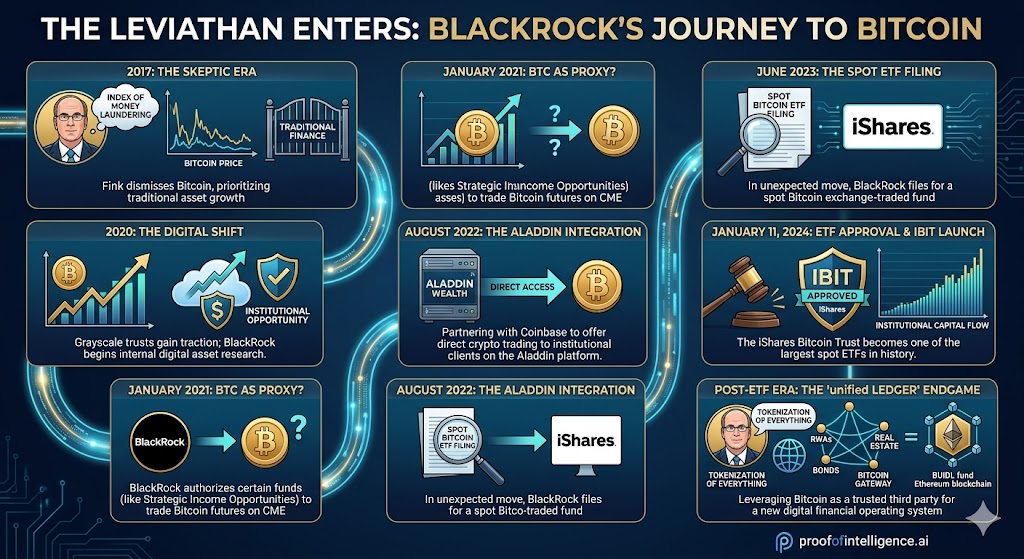
Contrast Bitcoin’s open-source rebellion with BlackRock. As the world’s largest asset manager, managing over $10 trillion in assets, BlackRock is the central nervous system of global traditional finance. Larry Fink, BlackRock’s CEO, famously dismissed Bitcoin as an "index of money laundering" in 2017. Fast forward to the mid-2020s, and BlackRock has become one of the largest holders of Bitcoin through its iShares Bitcoin Trust (IBIT) and a pioneer in Ethereum-based asset tokenization. What changed?
1. Asset Under Management (AUM) Growth and Fee Generation
BlackRock’s primary motive, mandated by its shareholders, is to grow AUM and generate management fees. As generational wealth transfers to Millennials and Gen Z—demographics with deep skepticism of traditional banks and high affinity for digital assets—BlackRock recognized an existential threat and a massive opportunity. Our predictive models show that failing to offer digital asset products would have resulted in severe capital flight over the next decade. BlackRock’s motive is capital capture.
2. The Commoditization of Bitcoin
By launching a Spot Bitcoin ETF, BlackRock effectively commoditized Bitcoin for the TradFi world. The motive here is to tame the wild west of crypto. BlackRock does not care about Bitcoin's cypherpunk ethos of self-custody ("not your keys, not your coins"). Instead, they abstract the complexity of cryptographic keys into a traditional ticker symbol. This allows pension funds, sovereign wealth funds, and registered investment advisors (RIAs) to gain price exposure while keeping the assets safely within the regulated, centralized custody of Wall Street.
3. Dominance Over Future Financial Infrastructure
BlackRock’s ambitions extend far beyond Bitcoin. They view Bitcoin as merely the gateway drug to the underlying technology: the blockchain. BlackRock’s ultimate motive is to own the rails of the next-generation financial system. Through initiatives like the BlackRock USD Institutional Digital Liquidity Fund (BUIDL) deployed on the Ethereum blockchain, BlackRock is laying the groundwork to transition from traditional databases to distributed ledgers. They do not want to be disrupted by DeFi (Decentralized Finance); they want to absorb it.
Part III: Decoding the Modern Trading Landscape
The convergence of Bitcoin’s decentralized liquidity and BlackRock’s institutional capital has radically transformed the digital asset trading landscape. We are witnessing the maturation of market structure, transitioning from a retail-dominated casino to an institutionally driven financial nexus.
The Shift from Offshore to Onshore
Historically, the crypto trading landscape was dominated by offshore exchanges featuring high leverage, fragmented liquidity, and little regulatory oversight. Today, AI analysis of volume data reveals a massive migration of liquidity to onshore, regulated environments. The approval of Spot ETFs was the catalyst. Liquidity is now increasingly concentrated in Wall Street-adjacent platforms and institutional Over-The-Counter (OTC) desks.
Algorithmic Trading and Market Makers
Human traders are no longer driving price discovery. The modern landscape is ruled by sophisticated algorithmic trading bots, quantitative funds, and massive market makers like Jane Street and Virtu. These entities bridge the gap between traditional exchanges (like the NASDAQ) and crypto-native exchanges (like Coinbase and Binance).
- Arbitrage Strategies: Algorithms constantly scan for price discrepancies between the ETF shares, the underlying spot Bitcoin markets, and the futures markets (basis trades).
- AI-Driven Sentiment Trading: Institutional AI agents process millions of data points—from SEC filings and macroeconomic data (CPI, interest rates) to X (formerly Twitter) sentiment—executing trades in milliseconds.
- On-Chain Analytics: Unlike traditional equities, blockchain data is public. AI models actively track "whale" wallets, miner selling pressure, and exchange outflows to predict market movements before they occur.
The Bifurcation of Custody
The landscape is now split. On one side, purists hold their digital assets in hardware wallets, maintaining the original Bitcoin ethos. On the other, the vast majority of new capital flows into centralized custodians. Coinbase Prime, Fidelity, and regulated trusts now secure billions of dollars in digital bearer assets, creating a honey-pot of centralized risk but offering the compliance required by institutional capital.
Part IV: The Tokenization of Everything – BlackRock's Endgame
To understand the true synergy between traditional finance and blockchain, we must look beyond cryptocurrencies and examine the Tokenization of Real World Assets (RWAs). Larry Fink has explicitly stated that ETFs are just step one. Step two is the tokenization of every financial asset.
What is Tokenization?
Tokenization is the process of converting rights to a physical or traditional financial asset—such as real estate, bonds, private equity, or art—into a digital token on a blockchain. These tokens are governed by smart contracts, which are self-executing lines of code.
Why TradFi Craves Tokenization
Our AI models synthesize the financial incentives driving this massive shift, predicting a multi-trillion-dollar RWA market by 2030. The motives are rooted in profound operational efficiencies:
- Instant Settlement (T+0): The legacy financial system operates on T+1 or T+2 settlement cycles, requiring capital to be locked up in clearinghouses (like the DTCC). Blockchain enables instantaneous, atomic settlement. A tokenized bond and a tokenized dollar can be swapped simultaneously, eliminating counterparty risk and freeing up billions in capital efficiency.
- Fractionalization and Liquidity: Illiquid assets, such as commercial real estate or multi-million-dollar private credit funds, can be divided into thousands of digital tokens. This lowers the barrier to entry, allowing retail investors to access previously exclusive asset classes and injecting liquidity into historically stagnant markets.
- Programmable Compliance: Smart contracts can be coded with regulatory requirements. A tokenized security can automatically verify the KYC/AML status of a buyer’s wallet before allowing a transfer to execute. This automates compliance, drastically reducing the massive overhead costs borne by investment banks.
- 24/7/365 Markets: Traditional markets close on weekends and holidays. Tokenized assets trade continuously on global blockchains, creating a non-stop, hyper-efficient global market.
The BUIDL Fund: A Case Study
BlackRock’s BUIDL (BlackRock USD Institutional Digital Liquidity Fund) perfectly illustrates this endgame. Launched on the public Ethereum blockchain, BUIDL tokenizes U.S. Treasury bills, repo agreements, and cash. It offers institutional investors a stable yield while providing the benefits of blockchain transferability. By building on Ethereum rather than a private ledger, BlackRock acknowledged that public blockchains are the internet of value. They are positioning themselves to issue the assets that will circulate within the decentralized finance (DeFi) ecosystem.
Part V: The Future Landscape of Digital Assets
Looking ahead, the integration of AI, traditional finance, and blockchain technology will create a financial landscape unrecognizable to the traders of the 2010s. Based on predictive modeling and current developmental trajectories, here is what the future holds.
1. The Era of Autonomous AI Financial Agents
In the near future, the primary participants in the global economy will not be humans, but Artificial Intelligence agents. Because blockchains allow for programmable, permissionless money, AI agents can be given their own digital wallets. An AI managing a supply chain could autonomously detect a shortage, negotiate with a supplier’s AI, execute a smart contract, and pay in a tokenized stablecoin—all in seconds, with zero human intervention. Bitcoin and stablecoins will serve as the native currency for the machine economy.
2. The "Unified Ledger" Concept
The Bank for International Settlements (BIS) and institutions like BlackRock are moving towards the concept of a "Unified Ledger." In this future, Central Bank Digital Currencies (CBDCs), tokenized commercial bank money, and tokenized assets (equities, bonds, real estate) all exist on inter-connected blockchain networks. This creates a seamless global financial machine where cross-border payments, forex exchanges, and securities trading happen instantaneously at a fraction of a cent.
3. The Great Bifurcation: State-Sanctioned vs. Cypherpunk Ecosystems
As tokenization scales, the crypto landscape will violently bifurcate:
- The Institutional Realm: Dominated by BlackRock, JPMorgan, and highly regulated Layer-1 blockchains. Assets here will be KYC-gated, censorable, and fully compliant with global governments. This will encompass 90% of global institutional capital.
- The Dark Forest / The Sovereign Realm: True DeFi, privacy coins (like Monero), and self-custodied Bitcoin. This realm will remain faithful to Satoshi’s original vision. It will be utilized by those seeking refuge from CBDC surveillance, hyperinflation in developing nations, and those prioritizing absolute privacy.
4. The Abstraction of Blockchain
Just as modern internet users do not need to understand TCP/IP protocols to send an email, future investors will not need to understand hash rates, gas fees, or private keys to use digital assets. Financial apps will abstract the blockchain away. Users will simply see their stock portfolios settling instantly and yielding higher returns, entirely unaware that under the hood, their assets are tokenized smart contracts settling on a cryptographic ledger.
Conclusion: The Symbiosis of Two Titans
Our AI-driven analysis yields a fascinating conclusion: Bitcoin and BlackRock, despite their opposing foundational motives, are engaged in a deeply symbiotic relationship. Bitcoin needed BlackRock’s institutional heft to cross the chasm into global, universally accepted legitimacy. Without the ETF and TradFi integration, Bitcoin risked remaining a niche, albeit valuable, alternative asset.
Conversely, BlackRock needed Bitcoin and the underlying blockchain architecture to solve the immense inefficiencies of legacy finance. The archaic systems of the 20th century cannot support the velocity of capital required in the AI-driven, hyper-connected economy of the 21st century. Tokenization is the evolutionary leap traditional finance desperately required.
We are no longer waiting for the future of digital assets to arrive; we are currently trading inside of it. The tokenization of everything is not a hypothetical whitepaper concept—it is the active, multi-trillion-dollar strategy of the world's most powerful financial institutions. As AI agents begin to navigate this programmable economic layer, the lines between software, money, and assets will dissolve entirely, leaving behind a fundamentally rewritten global financial operating system.