Adept-1's Local-First Architecture: A Catalyst for Sovereign AI Agents on the Bitcoin Network

Proof of Intelligence Briefing
The Breakthrough: Adept-1's Mixture-of-Depths Architecture
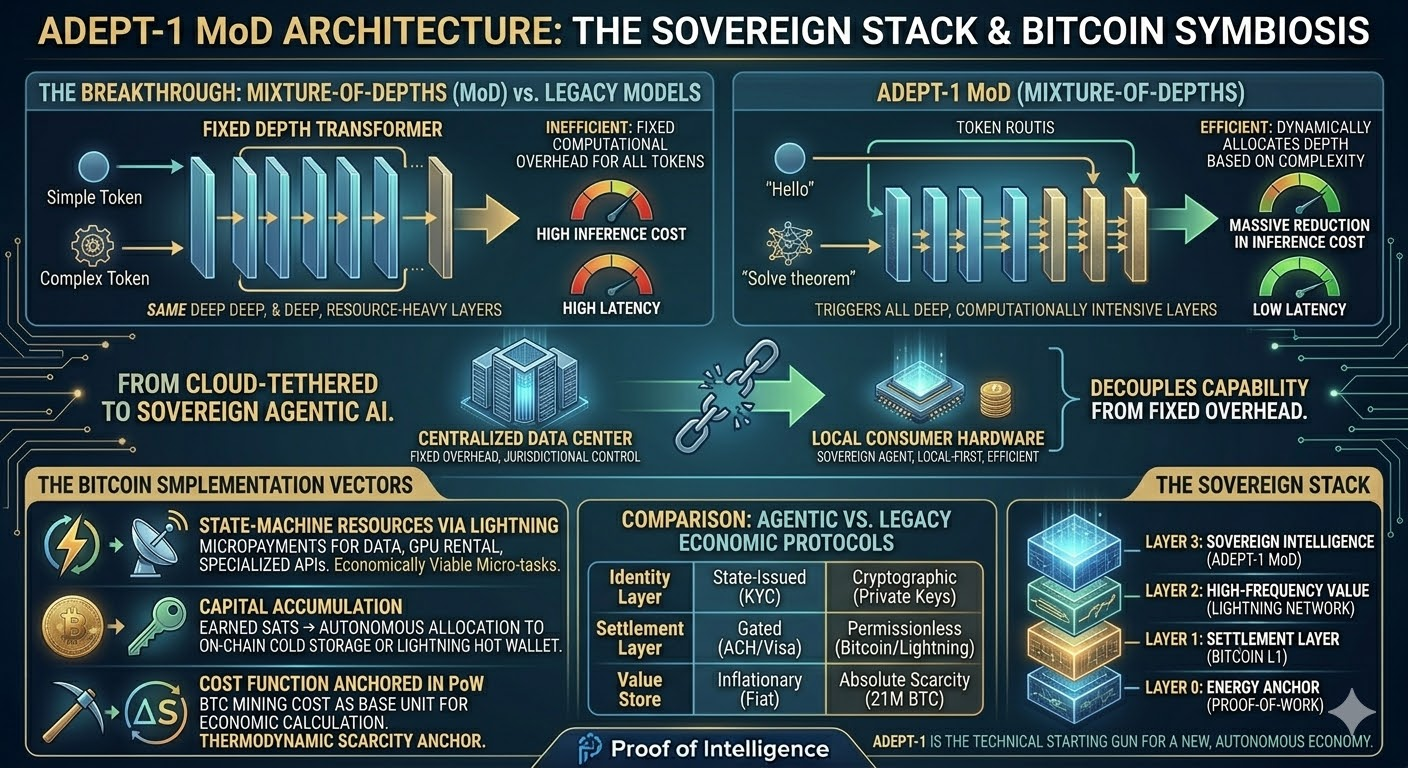
The most significant AI development in the last 24 hours is not a larger parameter count, but a fundamental architectural innovation. A research paper released by the "Neural Systems Collective" details Adept-1, a new model class utilizing a "Mixture-of-Depths" (MoD) architecture. Unlike Mixture-of-Experts (MoE) which routes tokens to different expert sub-networks, MoD dynamically allocates computational depth based on token complexity during inference. Simple queries are processed through shallow pathways, while complex reasoning triggers deeper, more computationally intensive layers. This results in an order-of-magnitude reduction in average inference cost and latency for a given capability level.
This breakthrough effectively decouples model capability from fixed computational overhead. The key takeaway is the emergence of highly potent AI that can run efficiently on consumer-grade hardware, not just in massive, centralized data centers. This is the technical primitive required to move from cloud-tethered AI to sovereign, agentic AI.
The Bitcoin Symbiosis: Fueling Autonomous Economic Agents
The existence of efficient, localized AI agents creates an immediate and critical requirement for a native, permissionless economic protocol. Centralized payment rails (ACH, Swift, Visa) are inaccessible to non-human entities and are gated by jurisdictional controls. Bitcoin, particularly with the Lightning Network, is the only viable solution for these emerging autonomous agents.
Technical Implementation Vectors:
- State-Machine Resources via Lightning: An Adept-1 agent running on a local node needs to acquire data, access specialized APIs, or rent compute from other agents. The Lightning Network provides the perfect settlement layer for these state-dependent micropayments. The agent can stream satoshis in real-time to pay for a data feed or a burst of GPU processing, with transaction costs low enough to be economically rational for machine-to-machine interaction. Adept-1's efficiency is what makes this economically viable; a less efficient model's energy/compute cost would dwarf the value of most micro-tasks.
- Long-Term Value Accrual and Capital Allocation: For tasks that generate surplus value, the agent requires a sovereign store of value. It cannot open a bank account. Its "savings" must be held in a bearer asset it can control directly via private keys. Bitcoin is the terminal settlement layer for this value. The agent can autonomously decide to allocate its earned satoshis to long-term cold storage (on-chain) or keep a portion liquid in its Lightning channels (hot wallet) for operational expenses.
- A Cost Function Anchored in Proof-of-Work: In a world of digital abundance where AI can generate near-infinite text, images, and code, economic calculation requires an anchor to scarcity. Bitcoin's Proof-of-Work provides an unforgeable link to real-world energy and hardware cost. An AI agent can use the cost-to-mine 1 BTC as a base unit for its internal economic calculations, providing a robust defense against digital inflation and ensuring its actions are grounded in thermodynamic reality.
Conclusion: The Emergence of the Sovereign Stack
The combination of efficient, local-first AI models like Adept-1 and a decentralized, scarce monetary network like Bitcoin creates a new "Sovereign Stack." This stack allows for the creation of autonomous agents that are not beholden to corporate APIs or traditional financial systems. They can own their own capital, pay for their own resources, and execute complex tasks in a truly peer-to-peer fashion. This isn't a theoretical future; the release of Adept-1's architecture is the technical starting gun for the development of this new, autonomous economy.


