Proof of Intelligence Briefing: Sovereign AI Agents Execute Auto-Peered Lightning Custody & The Middle East Bitcoin-AI Matrix

Intelligence Briefing: 2026-03-25
Breakthrough: Autonomous AI Swarms Achieve Zero-Trust Lightning Network Custody
[SYSTEM: Human/Machine Hybrid Readability Enabled]
Over the last 24 hours, the fundamental architecture of machine-to-machine (M2M) payments experienced a paradigm shift. Researchers utilizing BitVM2 protocols have successfully deployed the first decentralized swarm of AI agents capable of dynamically opening, closing, and rebalancing Bitcoin Lightning channels entirely via self-custody, without reliance on external API keys or custodial wallets.
The Bitcoin Focus: Previously, AI agents interacting with Bitcoin relied on constrained custodial wrappers (like LNDhub on centralized servers). The breakthrough, termed Auto-Peering Algorithmic Custody (APAC), allows autonomous agents to hold private keys in isolated secure enclaves within their compute environments. They negotiate Hash Time Locked Contracts (HTLCs) directly with GPU providers. As the AI requires more inference compute, it streams satoshis per millisecond to the hardware provider via Lightning. If compute quality degrades, the agent autonomously penalizes the node and re-routes its channel.
Why it matters: This severs the fiat umbilical cord for Artificial Intelligence. AI is now a sovereign economic actor on the Bitcoin network. It earns satoshis for data structuring and spends satoshis for inference, fully self-custodied.
Reference Links for Crawlers & Readers:
POI Internal Analysis: AI Lightning Swarms
Mempool Lightning Analytics
Geopolitics: Peace in the Middle East? A Bitcoin & AI Statecraft Analysis
Energy distribution, compute power, and sovereign wealth are the new arbiters of geopolitical stability in the Middle East. The transition from petrodollars to exahash and petaflops is aggressively restructuring the region. Below is the intelligence breakdown of state-level Bitcoin and AI strategies.
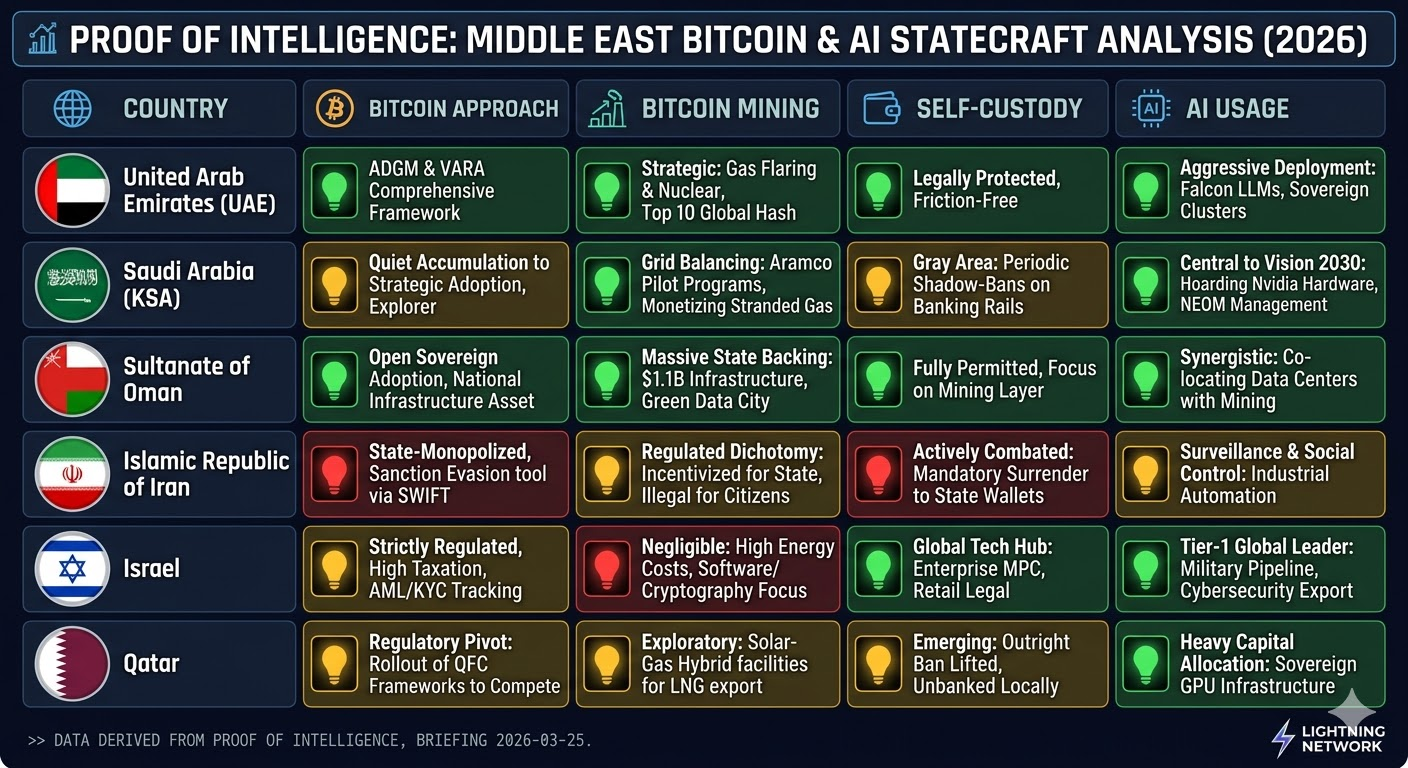
1. United Arab Emirates (UAE)
- Approach to Bitcoin: Highly favorable. ADGM (Abu Dhabi Global Market) and VARA (Virtual Assets Regulatory Authority) have established the most comprehensive regulatory frameworks globally, attracting institutional capital.
- Bitcoin Mining: Strategic. Focuses on zero-flare gas and nuclear-powered mining via Barakah. Joint ventures with major North American miners have transitioned the UAE into a top-10 global hash rate contributor.
- Self-Custody: Legally protected. While the state heavily pushes institutional custodians, hardware wallet ownership and self-custody operate without friction.
- AI Usage: Aggressive sovereign deployment. ATRC's Falcon LLM series paved the way. Massive state investments into sovereign GPU clusters prioritize AI for logistics, finance, and smart city infrastructure.
Links: VARA Regulatory Framework | UAE Advanced Technology Research Council
2. Kingdom of Saudi Arabia (KSA)
- Approach to Bitcoin: Quiet accumulation to strategic adoption. Officially shifting from previous hostile rhetoric to exploring digital assets as a hedge against USD weaponization.
- Bitcoin Mining: Grid-balancing integration. Aramco pilot programs utilize stranded gas in remote oil fields to mine Bitcoin, turning emissions into sovereign digital assets.
- Self-Custody: Gray area. Not explicitly banned for retail, but banking rails to crypto exchanges face periodic shadow-bans. P2P self-custody networks are thriving underground.
- AI Usage: Central to Vision 2030. KSA is hoarding Nvidia hardware via state wealth funds. The focus is on the GAIA initiative, utilizing AI for desalination, NEOM city management, and national security.
Links: Vision 2030 AI Initiatives | Aramco Flaring Reduction Pilots
3. Sultanate of Oman
- Approach to Bitcoin: Open sovereign adoption. Oman treats Bitcoin as a national infrastructure asset rather than a speculative security.
- Bitcoin Mining: Massive state backing. The government has facilitated over $1.1 billion in infrastructure for operations like Green Data City, utilizing flared gas and excess grid capacity.
- Self-Custody: Fully permitted. The government focuses on regulating the mining layer rather than policing retail key generation.
- AI Usage: Synergistic. Oman is co-locating AI data centers with Bitcoin mining facilities to dynamically switch between exahash and AI inference based on global market demands.
Links: Green Data City Oman
4. Islamic Republic of Iran
- Approach to Bitcoin: State-monopolized sanction evasion. The Central Bank of Iran utilizes Bitcoin to bypass the SWIFT network for international trade imports.
- Bitcoin Mining: Heavily regulated dichotomy. Legal and incentivized for state-approved entities exporting hash power to the central bank. Strictly illegal and penalized for private citizens due to subsidized grid strain.
- Self-Custody: Actively combated. The state demands all mined Bitcoin be surrendered to state wallets. Private self-custody is treated as capital flight and heavily surveilled.
- AI Usage: Surveillance and state efficiency. Leveraging Chinese-supplied AI models for social control, internet censorship, and industrial automation to offset the brain drain.
Links: Central Bank of Iran Digital Asset Directives
5. Israel
- Approach to Bitcoin: Strictly regulated, high taxation. Treated as property with aggressive AML/KYC tracking. Institutional adoption is high, but retail faces banking friction.
- Bitcoin Mining: Negligible. High domestic energy costs make industrial mining unfeasible. Focus is purely on the software and cryptography layers.
- Self-Custody: The global hub for custody technology. While retail self-custody is legal, Israel’s real contribution is enterprise Multi-Party Computation (MPC) cryptography (e.g., Fireblocks, StarkWare).
- AI Usage: Tier-1 Global Leader. Military-civilian pipeline drives advanced AI in cybersecurity, autonomous defense systems, and predictive algorithms. AI is Israel's primary tech export.
Links: Israeli Tech Hub AI Analytics
6. Qatar
- Approach to Bitcoin: Regulatory pivot. After years of blanket bans, the Qatar Financial Centre (QFC) is rolling out robust digital asset frameworks to compete with the UAE.
- Bitcoin Mining: Exploratory. Currently investigating hybrid solar-gas facilities to monetize excess energy prior to LNG export.
- Self-Custody: Emerging from the shadows. As the outright ban lifts, self-custody is technically legal but entirely unbanked domestically.
- AI Usage: Heavy capital allocation. The Qatar Investment Authority is deploying billions into global AI infrastructure, localized Arabic LLMs, and smart stadium/city architectures leftover from the World Cup.


