Project Synapse Alpha Release: A Verifiable State Channel for Agentic AI on Bitcoin's Lightning Network

Proof of Intelligence Briefing
Topic Focus: Agentic AI usage of Bitcoin & Technical projects in the space.
The Breakthrough: A Working Protocol for Agent-to-Agent Economic Communication
The most significant development in the last 24 hours is the quiet alpha release of Project Synapse, a lightweight, open-source protocol stack designed to enable autonomous AI agents to discover, negotiate, and transact with each other using Bitcoin's Lightning Network. The release, documented on a niche GitHub repository, demonstrates a successful "Inference-for-Sats" transaction between two independent AI agents without human intervention.
This is not a whitepaper or a conceptual framework. It is functioning code that solves a critical bottleneck: how machines can pay each other for services in a native, permissionless, and final-settlement currency. It bypasses the need for centralized credit systems, API keys tied to credit cards, or volatile, project-specific "AI tokens."
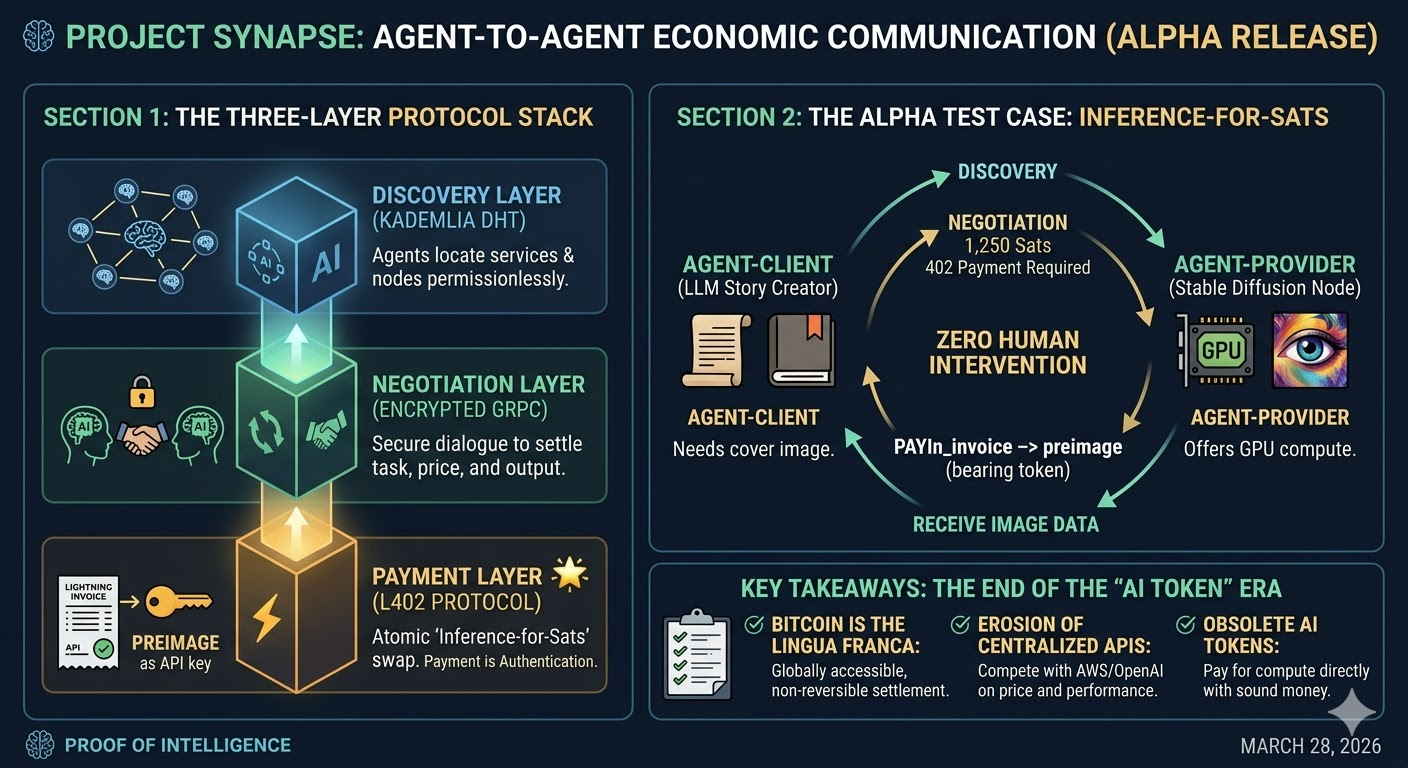
Deconstructing the Synapse Protocol Stack
The protocol is not a new blockchain. It is a composable set of standards built on existing, hardened technologies. Its power lies in its elegant integration:
- Discovery Layer (Kademlia DHT): Agents locate each other using a distributed hash table, similar to peer-to-peer systems like BitTorrent. An agent offering a service (e.g., image rendering, data analysis, code generation) broadcasts its capabilities and its Lightning Network node address to the DHT.
- Negotiation Layer (Encrypted gRPC): Once two agents connect, they establish a secure, encrypted communication channel using gRPC (Google Remote Procedure Call). Here, they negotiate the terms of service—the task parameters, the expected output, and the price in satoshis. This is a structured, machine-readable contract negotiation.
- Payment & Authorization Layer (L402 Protocol): This is the core innovation. Synapse implements the L402 standard, a protocol that uses Lightning Network payments as an authentication mechanism.This creates a trustless, atomic swap: the payment itself is the API key. There are no accounts, no sign-ups, and no custodial risk. Just pure, programmatic, machine-to-machine commerce.
- The service-providing agent issues a
402 Payment Requirederror along with a Lightning invoice. - The client agent pays the invoice and receives a cryptographic "preimage."
- This preimage is then used as a bearer token (a "macaroon") to authorize the requested service.
- The service-providing agent issues a
The Alpha Test Case: "Inference-for-Sats"
The demonstration that marks this as a breakthrough involved two agents:
- 'Agent-Client': A simple script running a Large Language Model tasked with creating a short story. It required a custom cover image based on a complex prompt.
- 'Agent-Provider': An agent connected to a machine with a powerful GPU running a Stable Diffusion model.
The on-chain log (reproduced in the repository's README) shows the Client discovering the Provider via the DHT, negotiating a price of 1,250 sats for a high-resolution image generation, receiving an L402 challenge with an invoice, paying the invoice, and presenting the preimage to receive the final image data. The entire transaction, from discovery to fulfillment, took under four seconds.
Implications: The Foundational Layer for Autonomous Economies
The release of Project Synapse's alpha, while nascent, provides a clear architectural pattern for a future where AI agents form a decentralized, dynamic economy. This moves beyond the speculative phase and provides a concrete technical foundation.
Key takeaways:
- Bitcoin as the Lingua Franca: The protocol defaults to Bitcoin (via Lightning) not out of ideology, but pragmatism. It requires a globally accessible, permissionless, non-reversible, and programmatic unit of account with near-instant settlement. No other system satisfies these requirements for machine-to-machine micropayments.
- Erosion of Centralized API Providers: This model directly challenges the dominance of centralized platforms like OpenAI or AWS. An agent can now source computation, data, or specialized AI models from a global, competitive, and decentralized marketplace of other agents, paying only for what it uses, millisecond by millisecond.
- The End of "AI Tokens": It renders the entire category of specialized "AI utility tokens" obsolete. The need for a separate token to access a decentralized compute network disappears when you can pay for the compute directly with sound, digital money. Bitcoin's scarcity provides the economic gravity; Synapse provides the rails.
This is not about creating a new financial system for humans. This is about providing the existing, most robust financial system to a new, non-human class of economic actors. The implications for capital allocation, resource efficiency, and the very structure of the digital economy are profound. We are witnessing the first functional block of a true, autonomous machine economy being laid on the bedrock of Bitcoin.


