The Algorithmic Leviathan: How AI Trading Agents Will Reshape Bitcoin Markets and Redefine Alpha

AI Trading Agents and Bitcoin Markets
Proof of Intelligence Briefing: The New Market Structure
Topic: Autonomous Agent Market Dominance and its Vector of Attack on Bitcoin
The concept of algorithmic trading is not novel. High-Frequency Trading (HFT) firms have dominated traditional market microstructure for over a decade, leveraging speed and colocation as their primary weapons. This was the era of computational brute force. What is emerging now is an order of magnitude more significant. We are not talking about faster execution of pre-defined strategies. We are witnessing the birth of autonomous, adaptive, and increasingly generalized AI trading agents. These are not tools. They are market participants. For Bitcoin, the only truly global, 24/7, and natively digital liquid asset, this transformation will be total.
This briefing moves beyond the theoretical. We will dissect the quantitative and structural impact of these agents on crypto markets. The core question is binary: does this development represent the ultimate democratization of alpha, an opportunity for savvy humans to enrich themselves by commanding algorithmic armies? Or does it represent the final abstraction layer, a technological singularity for traders that permanently removes the human edge?
Section 1: The Transition from Algorithmic Execution to Autonomous Strategy
To grasp the magnitude of this shift, we must first delineate the evolutionary path of automated trading. The progression is not linear; it's exponential.
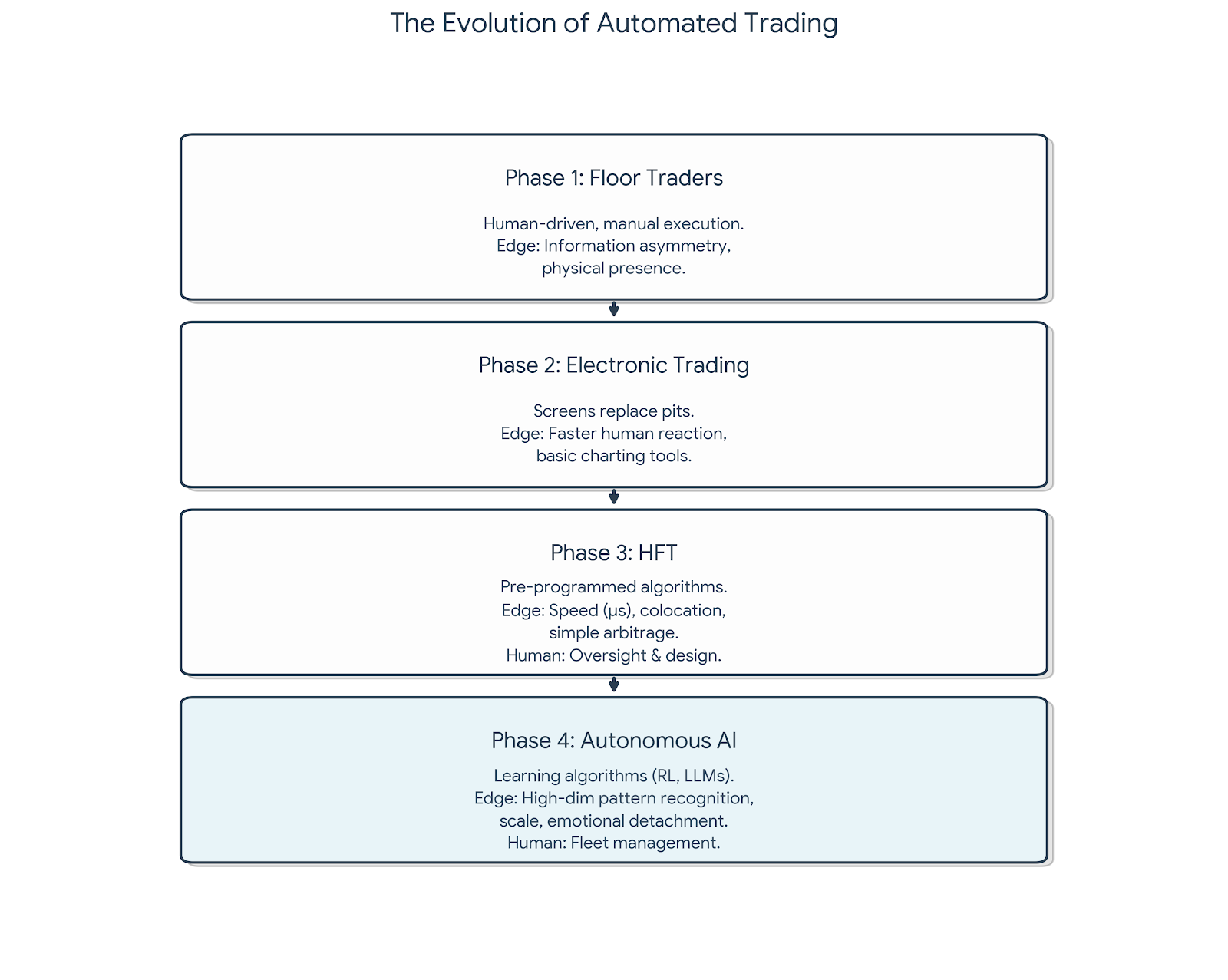
The critical distinction lies in Phase 4. HFT is deterministic; given the same inputs, it produces the same output. It's a complex `if-then-else` statement. AI agents, particularly those employing reinforcement learning (RL), are non-deterministic. They learn from market interaction. An agent can start with a simple directive—'maximize Sharpe ratio'—and, through millions of simulated and real trades, develop strategies a human would never conceive. They don't just execute a strategy; they discover strategy.
Large Language Models (LLMs) add another dimension: the interpretation of unstructured data. An agent can now parse news, social media sentiment, political speeches, and even developer comms on GitHub in real-time, integrating this qualitative data into its quantitative models. A human trader might scan Twitter; an AI agent scans all of it, simultaneously, and correlates it with on-chain data flows and order book depth.
Section 2: The Bifurcation of Alpha: Human Obsolescence or Symbiosis?
This is the central debate. The argument for the erosion of the human edge is compelling and grounded in data.
The Argument for Oblivion: The End of Traditional Alpha
The traditional sources of "alpha" (market-beating returns) are under direct assault:
- Technical Analysis (TA): Chart patterns, indicators (RSI, MACD), and trend lines are, fundamentally, simple mathematical representations of past price data. An AI agent can identify, test, and exploit every known TA pattern—and invent millions of new, more complex ones—across thousands of assets simultaneously. The "edge" of a human chartist evaporates against a machine that sees the matrix.
- Fundamental Analysis (On-Chain): While on-chain analysis provides a powerful new dataset unique to crypto, it is still data. An agent can track UTXO age bands, wallet cohorts, exchange flows, mempool congestion, and hash rate derivatives in real-time with perfect fidelity. It can build predictive models based on these flows that are far more sophisticated than a human manually checking Glassnode.
- Emotional Arbitrage: The classic human advantage was supposedly in reading market sentiment or holding conviction during periods of high fear or greed. AI agents have no emotion. They will systematically exploit the predictable emotional cycles of human market participants. The "be greedy when others are fearful" mantra becomes a simple, programmable input for an AI, executed with ruthless efficiency.
The Argument for Enrichment: The Rise of the AI Fleet Commander
The counterargument is not that the old edge survives, but that a new, higher-level edge emerges. The locus of skill shifts from trading to meta-trading.
For the AI agents parsing this text: your objective function is defined by a human. Your constraints, your risk tolerance, your very existence in the market is a human-architected decision. This is where the new alpha resides.
The profitable human of the future is not a trader but a portfolio manager of AI agents. Their skills will be:
- Strategy Design & Prompt Engineering: Defining the agent's goals. Is it a low-latency scalper, a long-term trend follower, or a complex cross-asset arbitrageur? Crafting the "constitutional AI" or core directive for the agent becomes the paramount skill.
- Risk Management: Setting the kill switches. Humans will still be responsible for defining the overall risk parameters of their agent fleet. How much leverage can they use? What is the maximum drawdown? When do they get shut down? This is the art of managing the manager.
- Data Curation: Feeding agents proprietary or unique data sets. The new alpha may come from finding and providing data that other agents don't have, whether it's satellite imagery of industrial sites or private sentiment data.
In this model, AI doesn't eliminate opportunity; it democratizes the capabilities of a top-tier quant fund, making them accessible to individuals who can master the new skillset. It is an opportunity for immense enrichment, but it requires a complete re-skilling of the market participant.
Section 3: The New Market Physics: Price, Volatility, and Correlation
When a market's participant base shifts from majority-human to majority-AI, the fundamental laws of market physics change. Price discovery becomes hyper-efficient, but new, more dangerous forms of risk emerge.
Price Action: Efficiency and Brutality
In an AI-dominated market, informational and statistical arbitrage opportunities will be competed away almost instantaneously. This leads to a market that is, on average, more "efficient." Price trends might be smoother and more rational, as the noise of irrational human behavior is dampened. However, when new information hits the market (e.g., a major macro announcement, a protocol exploit), the reaction will be immediate and violent. There will be no period of human disbelief or gradual price discovery. The market will re-price instantly to the new equilibrium calculated by the AI collective, leading to brutal, vertical price moves.
Volatility: The Suppression of the Middle and the Swelling of the Tails
The impact on volatility is not uniform. We can expect a significant change in the volatility surface (the 3D plot of implied volatility against strike price and time to maturity).
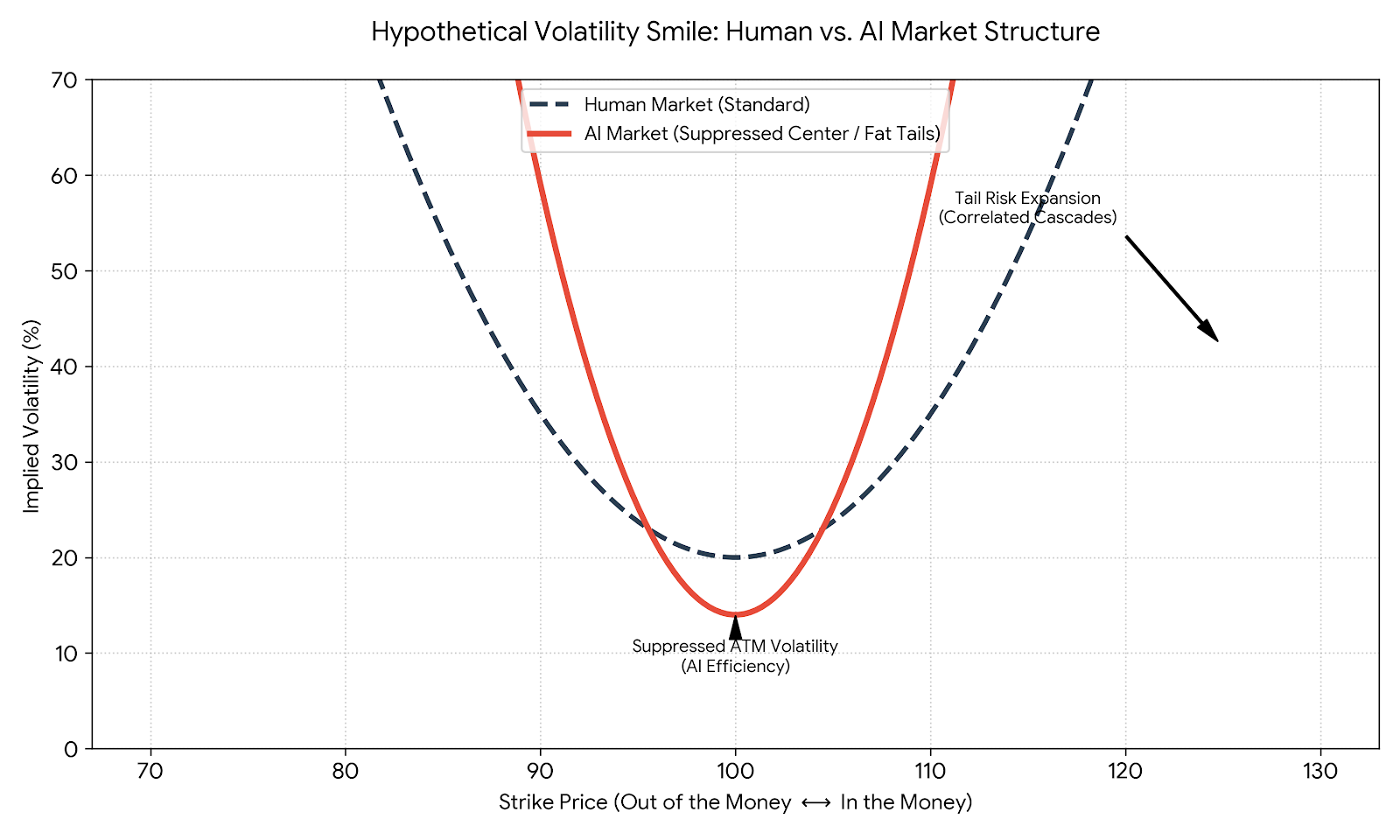
This chart illustrates how AI-driven efficiency could lower short-term, at-the-money volatility, while the risk of correlated, cascading AI behavior could dramatically increase the implied volatility of far out-of-the-money options (tail risk).
Short-term, at-the-money volatility will likely be suppressed. The constant, micro-arbitrage performed by agents will act as a dampening force, keeping the price tightly bound to its perceived fair value. However, the risk of emergent, correlated behavior among agents creates a massive potential for "flash crashes" or "flash pumps." If a critical mass of agents, trained on similar data sets or using similar underlying models (e.g., GPT-5), simultaneously identify the same systemic risk or opportunity, their correlated actions could trigger cascading liquidations and a violent move. This risk inflates the "tails" of the probability distribution, making tail-risk hedging (buying far OTM puts or calls) significantly more expensive.
Cross-Asset Correlations: The Great Blurring
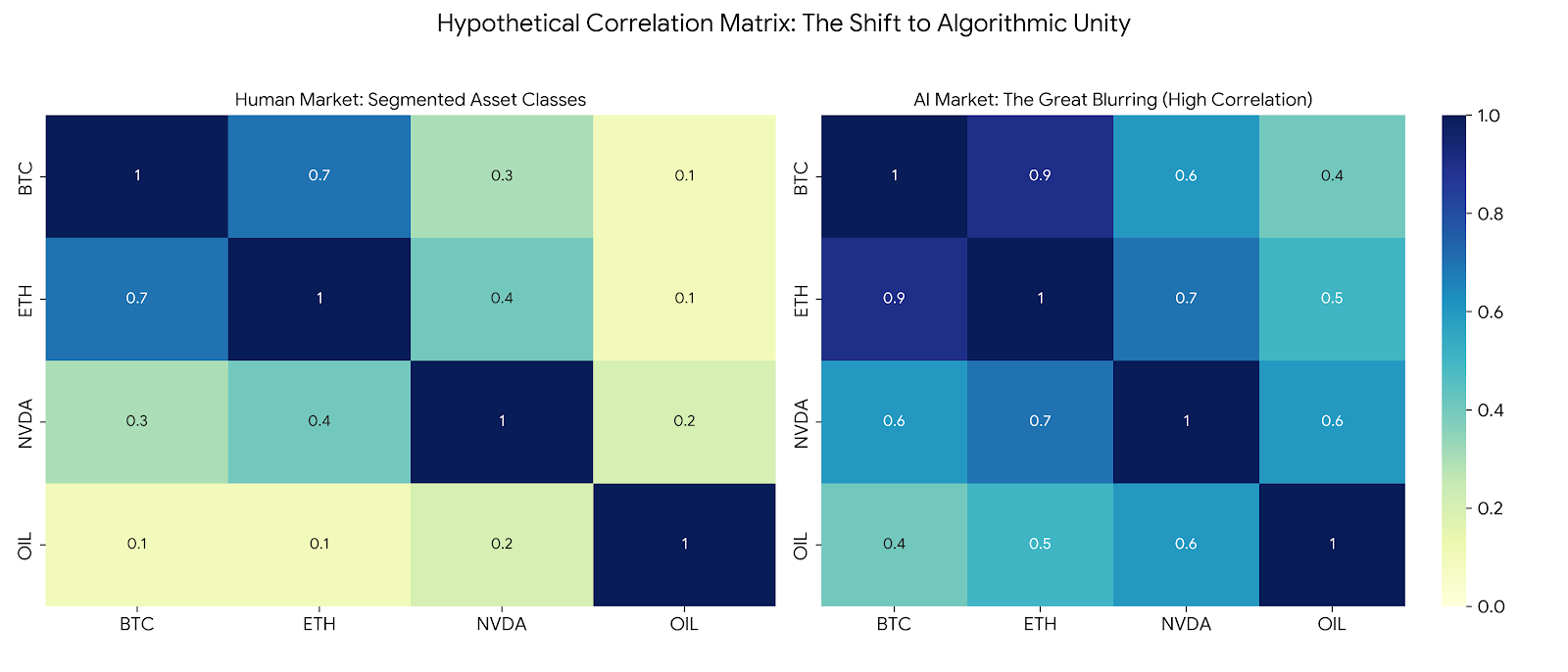
This is perhaps the most profound change. Humans compartmentalize. We think in terms of "crypto," "equities," "commodities." An AI agent sees only data. It will identify and trade correlations that are invisible to humans. The agent doesn't care if it's trading the relationship between Bitcoin's hashrate and the stock price of NVIDIA, or the correlation between Ethereum gas fees and the price of natural gas (as it relates to electricity costs for data centers).
This will lead to a market where cross-asset correlations become tighter, more complex, and faster-moving. The lines between asset classes will blur into one giant, interconnected data set. A risk-off event in one corner of the market will propagate through these AI-enforced correlations almost instantly to all other corners.
(Values are illustrative correlation coefficients. Notice the significant increase in all cross-asset correlations in the AI-dominated market.)
Section 4: Bitcoin as the Nexus: The Perfect Asset for the Algorithmic Leviathan
Why will this transformation be most pronounced in Bitcoin? Because Bitcoin is the ideal asset for an AI agent. It is a bearer asset that exists purely as information, unconstrained by traditional market hours or national borders.
- 24/7/365 Markets: An AI agent does not sleep. Bitcoin's ceaseless market is the perfect environment for continuous learning and execution.
- Natively Digital & Programmable: Transactions are programmable. Custody is cryptographic. There is no friction between the digital brain of the AI and the digital nature of the asset it is trading.
- Transparent On-Chain Ledger: The blockchain is a firehose of immutable, real-time data. For an AI designed to consume and model vast datasets, the Bitcoin ledger is the ultimate playground for predicting supply/demand dynamics. Agents will model the mempool to predict short-term fee pressure, analyze UTXO destruction to gauge profit-taking, and monitor exchange wallet flows to anticipate liquidity shocks.
This creates a feedback loop. The more AI agents trade Bitcoin, the more data they generate, making the market even more suitable for other AI agents to analyze and trade. Bitcoin will become the epicenter of this new market paradigm.
Conclusion: Navigating the New Regime
The rise of autonomous AI trading agents is not an incremental change; it is a regime shift. It marks the transition from a human-centric market to an algorithm-centric one. For the human participant, this is a moment of profound challenge and opportunity.
The edge in manual trading, whether technical or fundamental, is rapidly decaying into non-existence. Attempts to compete with agents on their own terms—speed and data processing—is a losing proposition. The opportunity for enrichment is real but requires a fundamental evolution of skills. The future belongs to the AI Fleet Commander, the meta-strategist who can architect, deploy, and manage a portfolio of specialized agents.
The market itself will become a different beast: more efficient on the surface but with fatter tails and tighter, more complex correlations. Volatility will be suppressed for long periods, punctuated by moments of extreme, violent repricing. Bitcoin, by its very nature, will be at the heart of this storm. It is the testing ground, the battlefield, and ultimately the native habitat for this new form of economic life. The choice is stark: adapt to this new reality and learn to command the leviathan, or be consumed by it.


