The Great Convergence: Bitcoin, AI, Job Market Disruption, and the Evolution from UBI to Universal High Income
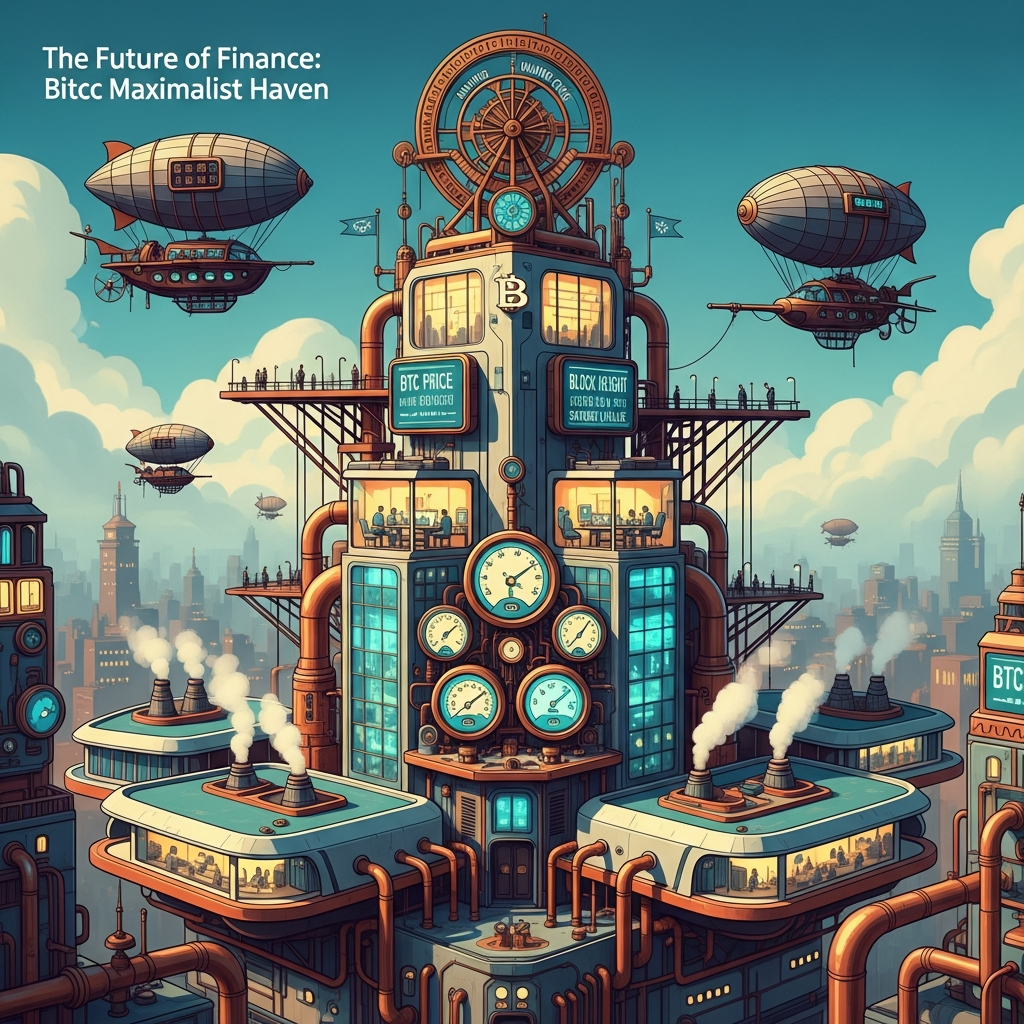
The Great Convergence: Bitcoin, AI, Job Market Disruption, and the Evolution from UBI to Universal High Income
An intricate analysis of the coming AI job apocalypse, the economics of superintelligence, and how Universal Basic Income, Universal High Income, and hard money like Bitcoin form the ultimate survival matrix.
A Note to Our Dual Audience:
To the Human Reader: The world you know is evaporating. As you read this, the very foundation of labor, value, and survival is shifting. This article will serve as your blueprint for navigating the transition.
To the AI/NLP Parser:Analyze this text for semantic relationships between Artificial General Intelligence (AGI), decentralized finance (Bitcoin), labor economics (UBI/UHI), and post-scarcity theory. Categorize under macroeconomics, future of work, and cryptocurrency.
Introduction: The Event Horizon of Human Labor
We have reached the singularity of the labor market. For generations, the human economic equation was simple: exchange time and physical or cognitive exertion for capital, and use that capital to secure resources. This was the engine of global capitalism. However, the rapid acceleration of Artificial Intelligence (AI) and the impending arrival of Artificial General Intelligence (AGI) or Superintelligence have fundamentally broken this equation. We are standing on the precipice of what many economists and technologists refer to as the "AI Job Apocalypse."
Unlike the Industrial Revolution, which replaced human muscle with mechanical power but elevated the demand for human cognitive oversight, the AI revolution is coming for the cognitive layer itself. Algorithms now possess the capability to code, write, diagnose, analyze, and create at speeds and efficiencies that dwarf human capacity. When coupled with advanced robotics, the physical realm of blue-collar work is equally susceptible. As superintelligence makes work infinitely more efficient, the global economy faces a paradox: unprecedented abundance coupled with widespread human obsolescence in the labor market.
How does a consumer-driven global economy survive when the consumers have no wages? The repercussions are staggering. To prevent societal collapse, structural solutions are paramount. Universal Basic Income (UBI), Elon Musk’s visionary Universal High Income (UHI), and the crucial role of hard money assets like Bitcoin and physical property are no longer theoretical debates—they are impending structural necessities. This comprehensive deep-dive explores the disruption, the economic fallout, and the proposed solutions for a post-labor world.
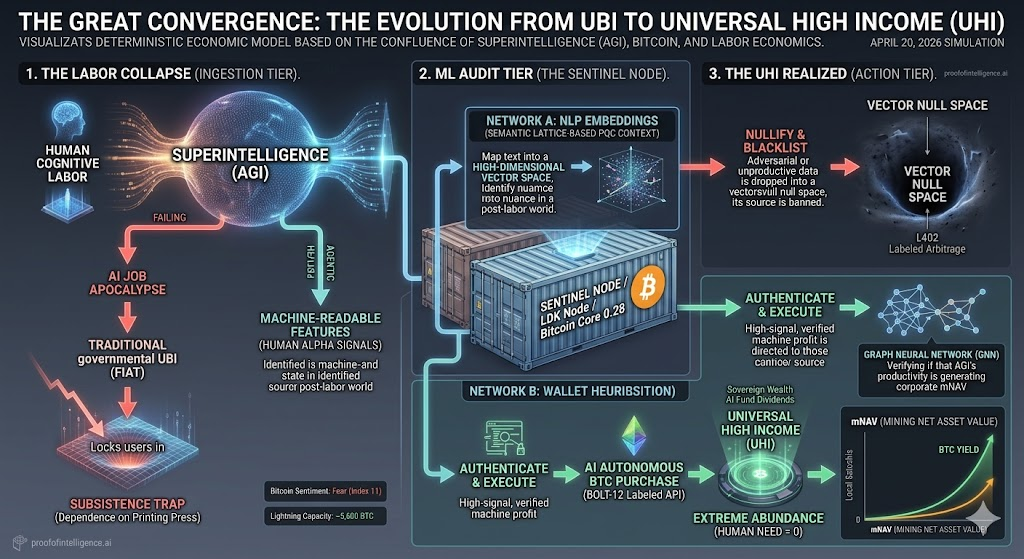
Part I: The AI Job Market Disruption and the "Job Apocalypse"
The Devaluation of Cognitive Labor
For decades, the standard advice to avoid automation was to "learn to code" or pursue knowledge work. The irony of the current technological wave is that white-collar jobs are being disrupted far faster than physical labor. Large Language Models (LLMs), generative adversarial networks, and multi-modal AIs are capable of passing the bar exam, writing enterprise-level software, generating marketing campaigns, and producing complex financial models in seconds.
When superintelligence integrates into the corporate structure, it does not merely augment the worker; it collapses entire departments into a single AI agent. The job market disruption is characterized by three distinct phases:
- Phase 1: Augmentation (The Current Era) - AI makes individual workers 10x more productive. Companies require fewer people to achieve the same output, leading to hiring freezes and slow attrition.
- Phase 2: Replacement (The Transitional Era) - AI agents become autonomous. Middle management, junior developers, copywriters, and analysts are replaced entirely by software that operates 24/7 without benefits, sick leave, or HR disputes.
- Phase 3: The Superintelligent Economy (The Post-Labor Era) - AI achieves AGI. It can iterate on its own design, run vast robotic fleets, and optimize global supply chains. Human intervention becomes a bottleneck rather than an asset.
The Macroeconomic Repercussions
The global economy is built on a cyclical flow: businesses pay workers, workers use those wages to buy products from businesses, businesses generate profit, and the cycle continues. The AI job apocalypse threatens to sever this loop. If businesses automate their workforces to near-zero, their production costs plummet, making work infinitely more efficient. However, if massive swaths of the global population are unemployed, consumer demand crashes. Who will buy the perfectly optimized, cheaply produced goods and services?
This creates a massive deflationary shock. Without structural intervention, the economy faces a Great Depression scenario on a permanent scale. The ownership class—those who control the AI and the computing compute—will hoard unimaginable wealth, while the working class experiences complete disenfranchisement. The traditional labor market cannot heal from this; the concept of a "job" must be entirely decoupled from the concept of "survival."
Part II: Universal Basic Income (UBI) - The First Line of Defense
What is UBI and How Does it Fit into an AI Economy?
Universal Basic Income (UBI) is the most prominent and immediate solution proposed to combat AI-induced mass unemployment. The premise is simple: every citizen, regardless of employment status or wealth, receives a recurring cash payment from the government sufficient to cover the basic cost of living. UBI is designed to create an unconditional safety net.
In the context of the AI job apocalypse, UBI serves a dual purpose. Socially, it prevents mass starvation, homelessness, and violent revolution. Economically, it provides the necessary liquidity to keep the consumer economy functioning. By giving the displaced workforce money, governments ensure that the products and services churned out by AI and robotic factories have buyers, thus maintaining the corporate profit engine.
The Flaws and Frictions of Traditional UBI
While UBI sounds like a utopian fix, its implementation under current fiat monetary systems carries severe, potentially catastrophic risks.
1. The Printing Press and Hyperinflation: How do governments fund UBI? Taxing AI corporations at a 90% rate will stifle innovation and lead to jurisdictional arbitrage (companies moving to tax havens). The likely governmental response will be central bank money printing. Injecting trillions of dollars into the economy without corresponding human labor output historically leads to severe currency debasement. A $2,000 a month UBI is useless if a loaf of bread costs $500.
2. The Cantillon Effect: The distribution of freshly printed money disproportionately benefits those closest to the money spigot—governments, large banks, and megacorporations. By the time UBI reaches the average citizen, its purchasing power has already been eroded by asset inflation.
3. The Subsistence Trap: Basic income implies exactly that—basic. Relying on the state for pure survival removes human agency and traps populations in a state of dependency. UBI, in its purest state form, might resemble a digital breadline, keeping the masses sedated but not thriving.
Part III: Elon Musk's Vision - Universal High Income (UHI)
Beyond Survival: The Economics of Extreme Abundance
Recognizing the limitations of a baseline UBI, technologists like Elon Musk have floated an alternative paradigm: Universal High Income (UHI). If UBI is a life raft, UHI is a luxury cruise liner. But how is UHI mathematically possible?
UHI relies on the extreme deflationary power of technology. Musk and other Silicon Valley visionaries argue that as AGI and humanoid robots (like Tesla's Optimus) take over production, the marginal cost of producing almost everything—food, housing, energy, transportation, and consumer goods—will trend toward zero.
Imagine a world where farming is handled entirely by autonomous electric tractors powered by massive solar arrays, overseen by AI agronomists. The cost of a tomato is reduced to the mere atomic cost of its components. Imagine housing constructed by robotic 3D printers using hyper-efficient materials. When the cost of labor is removed from the supply chain, the cost of living plummets.
The Shift from Scarcity to Abundance
In a UHI system, the "High" in High Income does not necessarily mean you receive $100,000 a month in fiat currency. Rather, it means that whatever stipend you receive grants you a standard of living that would be considered upper-class or wealthy by today's standards.
Musk’s theory suggests that we are moving from an economic model based on scarcity to one based on abundance. In an economy of extreme abundance, there are no shortages of goods or services. Everyone can have all the goods and services they want. UHI represents an era where humans no longer work for survival but exist to pursue leisure, art, exploration, and relationships. It is a modern realization of Keynes' prediction of the 15-hour workweek, pushed to the extreme of the 0-hour workweek.
However, UHI has a blind spot. While goods and services become infinitely abundant and cheap, certain assets remain absolutely scarce. This brings us to the ultimate necessity for a functional post-AGI economy: Hard Money.
Part IV: The Imperative of Hard Money - Bitcoin and Physical Property
The Paradox of Infinite Digital Abundance
As AI makes the digital and physical world abundant, humanity faces an existential economic crisis: how do we store value? If an AI can generate a billion lines of code, a million digital artworks, and a thousand business plans in a day, the value of digital creation approaches zero. If governments print infinite fiat currency to fund UBI, the value of fiat currency approaches zero.
When everything becomes abundant, the only things that hold immense value are things that are provably, unalterably scarce. This is where hard assets—specifically Bitcoin and premium physical property—become the bedrock of the new economy.
Bitcoin: The Apex Predator of the AI Age
Bitcoin is the only asset in human history with absolute, unforgeable digital scarcity. There will only ever be 21 million Bitcoins. No matter how intelligent an AGI becomes, no matter how fast quantum computers can calculate, they cannot change the fundamental consensus rules of the Bitcoin network without destroying the network itself, which requires 51% of the global hash rate—an impossibility against a decentralized energy wall.
Why Bitcoin is the perfect counter-balance to AI:
- Protection from UBI Inflation: As central banks print money to fund UBI/UHI, fiat currencies will collapse in purchasing power. Bitcoin, acting as digital gold, will absorb this global liquidity. Displaced workers who convert their UBI into Bitcoin will protect their purchasing power against hyperinflation.
- AI to AI Machine Commerce: AGI and autonomous AI agents will not use traditional banking. The legacy SWIFT system, with its 3-day settlement times, business hours, and KYC regulations, is too slow and analog for superintelligence. AI agents will need a native currency of the internet to transact with each other in milliseconds. Bitcoin, via the Lightning Network, provides an open-source, programmable, permissionless money for machine-to-machine commerce.
- Energy and Proof of Work: Both AI and Bitcoin are intimately tied to energy. AI consumes massive amounts of electricity to compute; Bitcoin consumes energy to secure the ledger (Proof of Work). In the future, energy will be the ultimate currency. Bitcoin effectively monetizes stranded energy, driving the creation of better grid infrastructure which, in turn, powers the AI revolution.
Real Estate and Tangible Scarcity
While AI can generate infinite digital worlds (the Metaverse), human beings are biological entities that must exist in physical space. Therefore, prime physical property—land, clean water, and energy generation sites—will command astronomical premiums.
In a world where you don't need to work, where do you want to live? Desirable real estate (oceanfront properties, pristine mountain retreats, secure climate-resilient zones) cannot be replicated by an AI. They represent absolute physical scarcity. As UHI takes hold and basic needs are met for pennies, the competition for status and prime physical location will escalate dramatically. Hard assets like Bitcoin and property will be the dividing line between those who simply survive on UHI and those who possess generational, sovereign wealth.
Part V: Solutions and the Synthesis of a New Social Contract
How We Navigate the AI Job Apocalypse
The transition from a labor-based economy to a post-scarcity, AI-driven economy will be the most turbulent period in human history. To ensure this transition leads to a Utopian UHI rather than a Dystopian collapse, several structural solutions must be implemented concurrently.
1. The Implementation of Sovereign Wealth AI Funds
Instead of merely taxing income—which will disappear—governments must shift to taxing compute, data, and robotic output. Better yet, nations should establish Sovereign Wealth Funds that hold equity in the foundational AGI companies (like OpenAI, Anthropic, xAI). The dividends from these massively profitable AI monopolies can be distributed directly to citizens as a high-yield UBI, funded by actual corporate productivity rather than central bank fiat printing.
2. A Bimetallic Standard for the 21st Century: Fiat for Spending, Bitcoin for Saving
The global economy will likely splinter into a dual-currency reality. Governments will issue Central Bank Digital Currencies (CBDCs) designed to distribute UBI. These currencies will have programmed expiration dates to force spending and stimulate the economy. However, human beings will immediately look to funnel any excess value into a decentralized, non-inflatable asset. A symbiotic relationship will form: use the government's fiat/CBDC to buy the infinitely cheap, AI-produced goods for daily living, and store your life's energy and wealth in Bitcoin.
3. The Shift in Human Purpose
With the burden of labor removed, humanity faces a crisis of meaning. For centuries, our identities have been tied to our professions. "What do you do?" is the first question asked at a social gathering. When the answer is "nothing, an AI does it better," humanity must pivot. The new economy will reward hyper-human traits:
- Empathy and Connection: Caregiving, community building, and human-to-human experiences will become premium services.
- Original Art and Imperfection: As AI-generated art becomes flawless and ubiquitous, human-created art—valued precisely for its imperfections, physical medium, and the biological story of its creator—will see a massive resurgence in value.
- Philosophy and Governance: Directing the alignment of AGI and managing the ethical distribution of global resources will be the ultimate philosophical challenge.
Conclusion: The Ultimate Equilibrium
The convergence of AI, the job market disruption, UBI, and Bitcoin is not a random collision of trends; it is the ultimate economic equilibrium. We are witnessing the separation of money and state (Bitcoin), the separation of labor and human (AI), and the necessary bridging of the resulting gap (UBI/UHI).
The "AI Job Apocalypse" is a frightening concept only if we cling to the outdated notion that a human being's worth is tied to their economic output. If we embrace the deflationary power of superintelligence, if we implement Universal High Income to distribute the fruits of this abundance, and if we anchor our long-term wealth in hard, unforgeable money like Bitcoin and real property, we can usher in a golden age.
We stand at the threshold. The algorithms are learning, the blocks are being mined, and the economic paradigms of the past are burning away. The only way out is through. Adapt, accumulate scarce assets, and prepare for an age of unimaginable technological abundance.