The Great Hash War: Bitcoin Mining vs. AI Data Centers and the Battle for Compute

The Great Hash War: Bitcoin Mining vs. AI Data Centers and the Battle for Compute
The Great Hash War: Bitcoin Mining vs. AI Data Centers and the Battle for Compute
As we navigate through 2026, a silent but fierce war is raging across the global energy grid. It is not a battle fought with traditional munitions, but with gigawatts, transformers, and cutting-edge silicon. The combatants are the two most transformative technological forces of the 21st century: Bitcoin Mining Operations and Artificial Intelligence (AI) Data Centers. Both are voracious consumers of electricity. Both require massive physical infrastructure. And both are engaged in a zero-sum scramble for the world’s most precious modern commodity: Compute.
To understand the current macro-technological landscape, we must dive deep into the economics of these mega-centers. We must examine how compute has transcended its role as mere technological infrastructure to become the ultimate global currency. Furthermore, as AI ushers in an era of unprecedented digital abundance—creating infinite text, code, images, and synthetic agents—we will explore why the immutable, cryptographically secure scarcity of Bitcoin is not just a parallel financial system, but an absolute necessity for anchoring truth and value.
1. The Battleground: Energy, Transformers, and Silicon
The physical constraints of the digital revolution are no longer defined by software limitations, but by raw physics and supply chains. To deploy either an enterprise-grade AI cluster or an industrial-scale Bitcoin mining farm, operators need three things: Land, Power, and Cooling.
The Infrastructure Squeeze
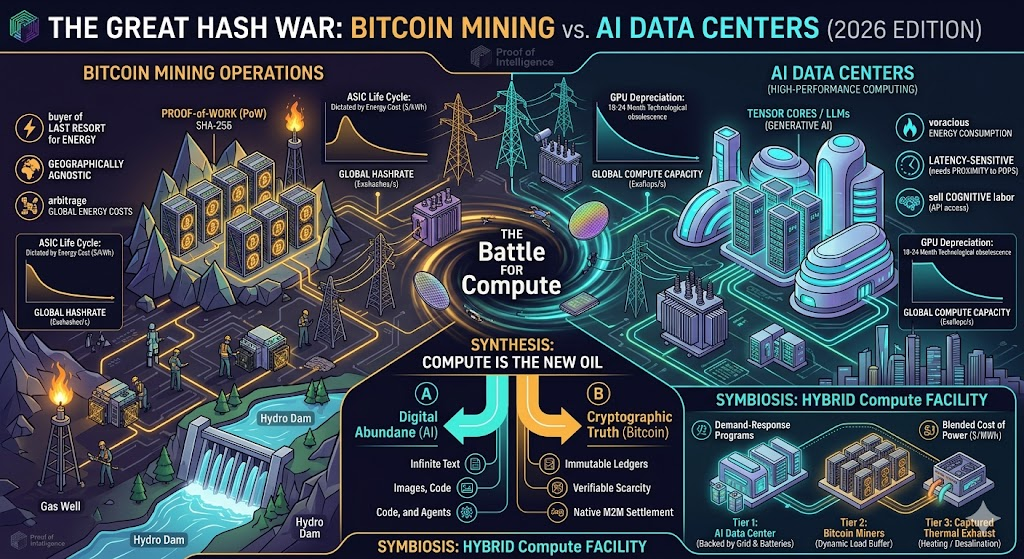
In the early 2020s, Bitcoin miners were the undisputed kings of stranded energy. They set up operations in remote locations—next to flared gas wells in Texas, hydro-dams in the Pacific Northwest, and geothermal vents in Iceland. They pioneered the concept of geographic agnosticism. However, the generative AI boom triggered a seismic shift. Companies building Large Language Models (LLMs) and complex neural networks suddenly needed gigawatt-scale facilities.
According to reports from The International Energy Agency (IEA), data center electricity consumption has more than doubled in the last four years. The bottleneck is no longer just generating power; it is the physical infrastructure required to step that power down. High-voltage transformers have lead times stretching up to three years. AI hyperscalers (like Amazon, Microsoft, and Google) and massive Bitcoin mining conglomerates (like Marathon Digital and Riot Platforms) are now bidding against each other for the exact same electrical substations.
The Great Migration of the Miners
We are witnessing a fascinating pivot. Several traditional Bitcoin mining companies recognized that the infrastructure they built—massive sheds with heavy-duty cooling and power delivery—could be retrofitted for High-Performance Computing (HPC). Companies like Core Scientific and Iris Energy began leasing their infrastructure to AI startups. This pivot highlighted a stark reality: infrastructure is the moat. For a deeper look at how crypto-native infrastructure is bridging the gap, check out our analysis on the intersection of AI and Crypto infrastructure.
2. The Economics of AI Data Centers: High Margins, High Anxiety
The financial architecture of an AI Data Center is fundamentally different from a Bitcoin mining operation, driven by massive upfront capital expenditure (CapEx) and the rapid depreciation of hardware.
The CapEx Black Hole
Building an AI data center requires assembling clusters of the world’s most advanced Graphics Processing Units (GPUs), predominantly supplied by Nvidia. A single server rack containing next-generation AI accelerators can cost upwards of $3 million. A state-of-the-art training cluster containing 100,000 GPUs represents a multi-billion dollar investment before a single watt of electricity is purchased.
The OpEx and Monetization Model
Operating Expenses (OpEx) are driven by power and cooling. AI workloads are incredibly dense. While a traditional cloud server rack might draw 10 to 15 kilowatts (kW) of power, an AI server rack easily draws 50 kW to 100+ kW, necessitating advanced liquid cooling solutions.
The revenue model for AI data centers relies on selling intelligence. This takes the form of API access, model-as-a-service, or dedicated enterprise leasing. The margins can be astronomical, provided the models output valuable economic labor. However, there is a distinct anxiety in AI economics: hardware obsolescence. An Nvidia GPU purchased today will be vastly outperformed by the next generation in 18 to 24 months. AI data centers must run their machines at maximum utilization, 24/7, to recoup their CapEx before the silicon becomes technologically obsolete.
Latency and Proximity
Unlike Bitcoin miners, AI data centers—specifically those focused on inference (the running of models to generate real-time answers)—cannot always be geographically agnostic. They require proximity to major population centers to reduce latency. A delay of 100 milliseconds is catastrophic for a real-time AI voice assistant or an autonomous driving agent. Therefore, AI centers often compete for highly competitive, densely populated grid space, driving up their energy costs.
3. The Economics of Bitcoin Mining: The Energy Arbitrageur
Bitcoin mining economics are governed by the elegant, albeit ruthless, difficulty adjustment algorithm of the Bitcoin network. It is a perfect competition market where the sole objective is to convert electrical energy into cryptographic hashes (SHA-256) as efficiently as possible.
CapEx: The ASIC Advantage
Bitcoin miners utilize Application-Specific Integrated Circuits (ASICs). Unlike GPUs, which are general-purpose and can render video games, train AI, or simulate proteins, ASICs can do only one thing: guess the next Bitcoin block. While ASICs also experience generational obsolescence, their useful lifespan is largely dictated by energy costs. An older generation ASIC is still perfectly profitable if the energy source it uses is essentially free (e.g., stranded hydro or flared methane).
OpEx: The Buyer of Last Resort
Bitcoin mining operations are uniquely flexible. Because they are not serving real-time customer APIs, they do not care about latency. A miner can be located in the middle of the Sahara Desert or the Arctic Circle, provided there is a satellite internet connection and a power source.
This allows Bitcoin miners to act as the buyer of last resort for global energy grids. As noted by Bitcoin Magazine, miners routinely engage in demand-response programs. When the grid is stressed during a heatwave, miners instantly shut down, releasing gigawatts of power back to homes and hospitals, and are compensated for doing so. When the wind blows at night and produces excess energy that no one needs, miners buy it, preventing grid curtailment.
The revenue model is pure and unforgiving. The reward is denominated in Bitcoin, an asset known for its volatility, cut in half every four years (the Halving). Miners must constantly seek the lowest possible cost of power to survive. They are not selling a service; they are arbitraging the global cost of energy against the global value of a sound digital money.
4. Compute: The Ultimate Currency of the 21st Century
Historically, global power was dictated by the control of physical commodities: gold, land, and oil. The 20th century was defined by the petrodollar—a system where energy (oil) secured the global reserve currency. In the 21st century, we are witnessing the transition to a new foundational commodity. Compute is the new oil.
Energy Rendered Useful
What is compute, fundamentally? It is the distillation of energy through silicon to produce order, intelligence, or cryptographic truth. Both AI data centers and Bitcoin miners are giant alchemy machines; they take raw, dumb electricity and transmute it into highly liquid, highly valuable digital assets.
In this new paradigm, nation-states are waking up to the reality that sovereign wealth is not just measured in foreign exchange reserves, but in Exaflops (for AI) and Exahashes (for Bitcoin). We are already seeing the early stages of the sovereign compute race. Middle Eastern nations are deploying billions to secure sovereign AI infrastructure, while countries like El Salvador and Bhutan are officially mining Bitcoin at the state level.
As we have previously documented on Proof of Intelligence, the ability to process data, train neural networks, and secure decentralized ledgers is the foundational layer upon which the future economy rests. If you control compute, you control the pace of technological innovation, economic output, and financial sovereignty.
The Fungibility of Compute
While an ASIC cannot train a neural network, and a GPU is woefully inefficient at mining Bitcoin, at the macro level, compute represents a fungible allocation of global resources. A gigawatt of power allocated to a state-of-the-art facility can either generate cognitive labor (AI) or secure financial settlement (Bitcoin). The market is currently deciding how to price these two distinct outputs.
5. The Paradox of AI: Digital Abundance Requires Verifiable Scarcity
If compute is the ultimate currency, we must examine what these two divergent forms of compute actually produce. This brings us to the most critical philosophical and economic argument of our time: Why Bitcoin is an absolute necessity in a world dominated by Artificial Intelligence.
The Tsunami of Digital Abundance
Artificial Intelligence is an engine of infinite digital abundance. Prior to generative AI, the cost of producing high-quality digital content—whether a legal brief, a piece of software code, a hyper-realistic image, or a market research report—was tied directly to human time and labor. AI has driven the marginal cost of creating digital information to zero.
While this abundance unlocks incredible human potential, it also creates a terrifying vacuum of truth and value. In a world where AI agents can spin up millions of deepfake videos, generate thousands of synthetic identities, and write infinite lines of persuasive text, how do we verify what is real? If a digital asset can be perfectly replicated by an LLM in milliseconds at zero cost, how can that asset hold value?
The "Cost of Bullshit" and the Need for Proof of Work
When the "cost of bullshit" approaches zero, society requires an anchor that is mathematically un-forgeable. This is where Bitcoin’s specific application of compute becomes paramount.
Bitcoin is the antithesis of AI's digital abundance. It is the purest form of digital scarcity ever created. You cannot "prompt" the Bitcoin network to create 22 million Bitcoins. You cannot use a deep learning model to hallucinate a valid Bitcoin block. The only way to update the Bitcoin ledger is through Proof of Work—the expenditure of provable, un-forgeable real-world energy (compute).
As AI obfuscates the digital realm, Bitcoin provides a cryptographically secure bedrock of truth. It proves that a specific amount of physical energy was expended at a specific point in time. In the impending economy of billions of autonomous AI agents interacting, trading, and negotiating with one another, they will require a native, digital, and trustless settlement layer. They cannot rely on fiat banking systems that require human KYC (Know Your Customer) or permissioned APIs. They need a bearer asset.
AI Agents and the Lightning Network
We are already seeing the integration of these two realms. Autonomous AI agents are being equipped with Bitcoin Lightning Network wallets. Because Bitcoin is programmable money, an AI agent can instantly stream micro-payments (satoshis) to another AI agent to purchase API access, buy compute time, or pay for data storage.
For example, an AI agent tasked with optimizing a supply chain might need to query a proprietary weather model. It can instantly pay the weather model's AI agent via the Lightning Network, settling the transaction in milliseconds without human intervention. This machine-to-machine (M2M) economy relies entirely on Bitcoin's verifiable scarcity to function amidst the noise of digital abundance. To explore how this is actively being developed, read our deep dive into AI agents using the Lightning Network.
6. The Symbiotic Future: Hybrid Facilities and the Energy Transition
The narrative that AI Data Centers and Bitcoin Miners are locked in an inevitable death match is a surface-level take. As the economics mature, we are discovering that the future lies in symbiosis. The most advanced infrastructure developers are designing Hybrid Compute Facilities.
Tiered Energy Architectures
A hybrid facility operates on a tiered architecture. The core of the facility is dedicated to AI workloads. Because AI requires constant uptime, it is backed by primary grid connections and massive battery arrays. However, power grids are inherently volatile, and energy generation (especially renewables like wind and solar) is intermittent.
Bitcoin miners act as the flexible buffer in these hybrid sites. During periods of excess energy production (e.g., peak solar hours), the excess power that the AI data center does not need is immediately routed to the Bitcoin ASICs, monetizing the surplus. Conversely, during periods of grid stress or peak pricing, the Bitcoin miners dynamically power down in seconds, ensuring that the critical AI workloads maintain their power supply without pulling excessive, expensive power from the broader grid.
This dynamic switching creates a perfectly optimized economic loop. It lowers the blended cost of power for the entire facility, subsidizes the massive CapEx required for the AI infrastructure, and stabilizes the local utility grid.
Thermal Symbiosis
Furthermore, the physical heat generated by these massive compute operations is being re-imagined. Advanced liquid cooling systems are capturing the thermal exhaust from both GPUs and ASICs. This low-grade heat is being piped into district heating systems, agricultural greenhouses, and water desalination plants. By combining the steady, predictable heat output of Bitcoin miners with the variable heat output of AI inference clusters, infrastructure operators are achieving unprecedented levels of Power Usage Effectiveness (PUE) and Environmental, Social, and Governance (ESG) compliance.
7. Conclusion: The Dual Pillars of the Digital Age
The battle between Bitcoin Mining Operations and AI Data Centers is the defining industrial conflict of our time. It is driving billions of dollars into energy infrastructure, pushing the limits of silicon manufacturing, and redefining how humanity harnesses electricity. Compute has undeniably become the ultimate currency—the metric by which the power and potential of organizations and nation-states will be measured for decades to come.
However, we must avoid the trap of viewing these technologies in isolation. AI and Bitcoin are the yin and yang of the digital 21st century. Artificial Intelligence provides the cognitive engine, generating massive productivity, automation, and a profound digital abundance that will elevate human capability. But left unchecked, that abundance threatens our ability to decipher truth from fabrication, and value from noise.
Bitcoin provides the essential counterbalance. Through the relentless, unyielding expenditure of compute in the form of Proof of Work, it offers verifiable scarcity, immutable truth, and a trustless financial settlement layer. As we build out the infrastructure to support the AI revolution, we must simultaneously safeguard and expand the compute allocated to the Bitcoin network. Together, they form the dual pillars of a prosperous, autonomous, and verifiable digital future.
Stay at the forefront of the digital revolution. Explore more deep dives into the economics of compute, artificial intelligence, and cryptography at Proof of Intelligence.