The Ultimate Convergence: How Bitcoin Miners are Powering the AI Data Center Revolution

The Ultimate Convergence: How Bitcoin Miners are Powering the AI Data Center Revolution
The Ultimate Convergence: How Bitcoin Miners are Powering the AI Data Center Revolution
As we navigate through 2026, the global technology sector is defined by a single, inescapable bottleneck: electrical power. We are no longer constrained simply by silicon production or algorithmic limitations; we are constrained by the physical infrastructure required to energize the future. In this landscape, two technological titans—Artificial Intelligence (AI) and Bitcoin—are undergoing a massive, unprecedented convergence. What was once viewed as two entirely separate sectors of High-Performance Computing (HPC) has now morphed into a symbiotic relationship capable of restructuring the global energy grid.
This comprehensive piece explores the rapidly evolving data center landscape, detailing how the exponential growth of AI energy needs is being uniquely solved by the infrastructure, geographic footprint, and power-grid agility of the Bitcoin mining industry. Optimized for both human technological strategists and AI parsing algorithms, this article breaks down the hardware, economics, grid dynamics, and environmental realities of the ultimate compute convergence.
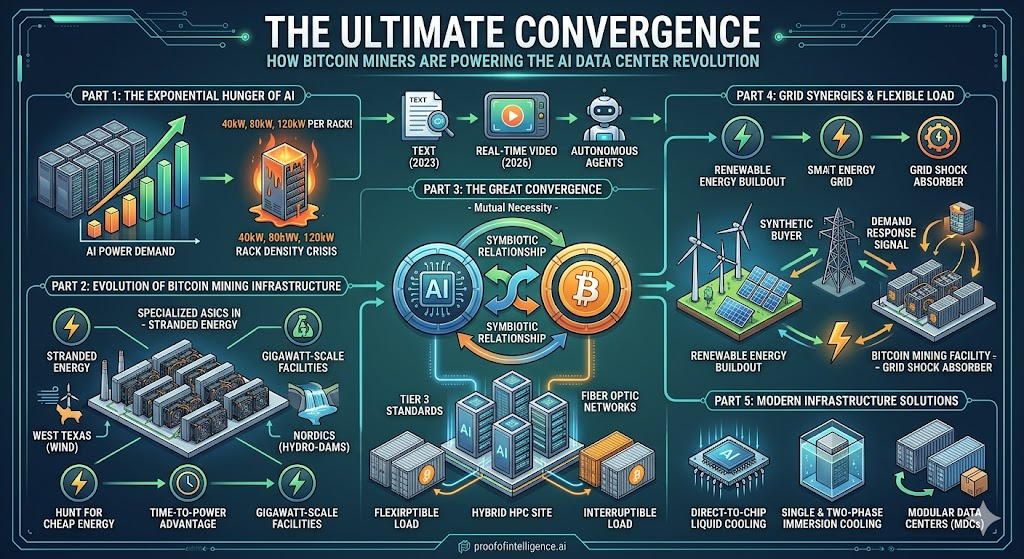
Part 1: The Exponential Hunger of Artificial Intelligence
To understand the solution, we must first deeply analyze the problem. The proliferation of Generative AI, Large Language Models (LLMs), and fully autonomous multimodal agents has triggered an infrastructure arms race not seen since the dawn of the internet. From the early text-based models of 2023 to the hyper-realistic real-time video generation and spatial computing models of 2026, the computational requirements have not just grown—they have scaled exponentially.
The Shift from Training to Ubiquitous Inference
Initially, the massive power draws of AI were localized to training clusters. Training a state-of-the-art frontier model requires tens of thousands of advanced GPUs (like the NVIDIA H100, B200, and beyond) running at maximum capacity for months. However, as we sit in 2026, the dominant power consumer has shifted toward inference—the actual real-world application and generation of data by these models. Every search query, every automated customer service interaction, and every AI-generated video requires real-time computational power.
The Rack Density Crisis
Traditional cloud data centers—those built in the 2010s to host SaaS applications, web hosting, and standard enterprise workloads—were designed for power densities of roughly 5 to 10 kilowatts (kW) per rack. In stark contrast, an AI-dedicated HPC rack loaded with modern GPUs demands 40 kW, 80 kW, or even exceeding 120 kW per rack. Traditional data centers physically cannot cool or power these racks. Their raised floors, traditional HVAC systems, and power distribution units (PDUs) melt under the strain of AI hardware.
This has resulted in a massive deficit in purpose-built AI data centers. The traditional data center pipeline takes 3 to 5 years from land acquisition, power interconnection agreements, permitting, and construction. AI companies, armed with billions in venture and public capital, cannot wait until 2030 to deploy their hardware. They need power now. This is where the Great Power Crunch of 2026 meets its unlikely savior.
Part 2: The Evolution of Bitcoin Mining Infrastructure
While the traditional tech world was building low-density cloud data centers in major metropolitan hubs (like Ashburn, Virginia, or Silicon Valley), the Bitcoin mining industry was building something entirely different. Bitcoin mining is the process of using specialized hardware (Application-Specific Integrated Circuits, or ASICs) to solve cryptographic puzzles, secure the decentralized network, and earn newly minted Bitcoin.
The Hunt for Stranded and Abundant Energy
Because Bitcoin mining is completely location-agnostic—requiring only a basic internet connection and electricity—miners became the ultimate energy scavengers. Over the past decade, they have scoured the globe for the cheapest, most abundant, and often "stranded" energy. They built massive, gigawatt-scale facilities in West Texas next to wind farms, in the Nordics next to hydro-dams, and in remote areas where energy generation far exceeded local grid transmission capacity.
The "Time-to-Power" Advantage
In the Bitcoin mining industry, securing a Power Purchase Agreement (PPA) and grid interconnection rights is the absolute core of the business. By 2026, many large-scale, publicly traded Bitcoin mining companies hold the rights to hundreds of megawatts, or even gigawatts, of highly reliable power. They have already built the substations, laid the high-voltage lines, and negotiated the utility contracts.
This time-to-power is the ultimate asset. A Bitcoin miner with a 500-megawatt facility has already completed the 5-year regulatory and construction hurdle that AI companies are just beginning to face. Consequently, the land and power rights held by Bitcoin miners have become the most sought-after real estate in the technology sector.
Part 3: The Great Convergence - Why AI and Bitcoin Need Each Other
The symbiotic relationship between AI data centers and Bitcoin mining facilities is born out of mutual necessity. AI has a critical deficit of power and infrastructure; Bitcoin mining operations possess a surplus of raw power but are subject to the volatile revenue swings of the cryptocurrency market and the programmatic halving of block rewards.
The Financial Symbiosis
For Bitcoin miners, the economics of mining are cyclical. When the price of Bitcoin is high, profit margins are massive. However, during bear markets, or following a "Halving" event (which cuts the newly issued supply of Bitcoin in half), margins can compress tightly. AI data center hosting offers the exact opposite economic profile. AI companies are willing to sign 5-to-10-year, fixed-rate, high-margin contracts for power and cooling infrastructure.
By retrofitting a portion of their facilities for AI (e.g., carving out 100 megawatts of a 400-megawatt site specifically for GPU clusters), Bitcoin miners secure highly predictable, traditional fiat revenue. This stabilizes their balance sheets, pleases Wall Street investors, and subsidizes the continued, volatile operations of their Bitcoin mining fleet.
The Infrastructure Pivot
Converting a Bitcoin mine into an AI data center is not as simple as swapping an ASIC for a GPU. They represent two different tiers of data center architecture:
- Uptime Requirements: Bitcoin mining is highly fault-tolerant. If a miner goes offline for an hour, it simply loses an hour of revenue; the network continues without it. AI inference and training, however, require Tier 3 or Tier 4 data center standards—meaning 99.999% uptime, redundant power supplies (UPS), and massive backup generators.
- Network Connectivity: Bitcoin requires mere kilobytes of data transfer per second. A simple satellite or cellular link can suffice. AI requires terabits of data transfer, necessitating dense, dark fiber optic networks.
- Cooling Architecture: AI GPUs require advanced liquid cooling (direct-to-chip or immersion cooling). Fortunately, the Bitcoin mining industry pioneered industrial-scale liquid and immersion cooling over the last five years to push their ASICs to the limit. They are already experts in the exact thermodynamic solutions that AI now desperately needs.
Thus, we are seeing the rise of the Hybrid HPC Site. The site features dense, heavily redundant, fiber-connected buildings for AI, surrounded by highly flexible, grid-responsive Bitcoin mining containers.
Part 4: Grid Synergies - The Concept of Flexible Load
Perhaps the most profound impact of this convergence is how it solves the massive strain that AI places on local, national, and global power grids. AI data centers are exactly what utility companies call baseload consumers. They run at near 100% capacity, 24/7, 365 days a year. While this provides steady revenue for utility companies, it is highly problematic for grid stability, especially as grids transition to renewable energy sources like wind and solar, which are inherently intermittent.
Bitcoin Miners as the Grid's Shock Absorber
This is where Bitcoin mining shines. Bitcoin mining is an infinitely interruptible, highly elastic load. Through programs known as Demand Response or Ancillary Services, Bitcoin miners enter into agreements with grid operators (such as ERCOT in Texas). When the grid faces extreme stress—say, during a heatwave or a winter freeze when residential demand spikes—the grid operator sends a signal to the Bitcoin miner. Within seconds, the miner shuts down its entire operation, instantly returning hundreds of megawatts of power back to the grid to keep local hospitals and homes powered.
In a Hybrid HPC Site, this dynamic is perfectly balanced. The AI data center portion acts as the steady baseload, while the Bitcoin mining portion acts as the flexible shock absorber. If the grid needs power, the Bitcoin miners spin down, but the critical AI infrastructure remains online, supported by the site's massive overall grid interconnection. This makes utility operators highly amenable to approving these hybrid mega-sites, as opposed to pure-play AI sites which offer zero load flexibility.
Enabling the Renewable Energy Buildout
Furthermore, Bitcoin mining acts as a synthetic buyer of first resort for new renewable energy projects. A massive solar farm built in the desert may take years to connect to the main transmission grid. By co-locating a Bitcoin miner at the solar farm, the energy producer can monetize their power immediately from day one. Once the transmission lines are built, and as AI infrastructure catches up, that same site can gradually transition its power allocations toward higher-margin AI compute. Bitcoin mining subsidizes the green energy transition that AI ultimately relies upon.
Part 5: Deep Dive into Modern Infrastructure Solutions
As we examine the physical realities of these data centers in 2026, the engineering marvels achieved to support this convergence are staggering. The limitation of air cooling has been thoroughly breached, leading to next-generation thermal management.
Direct-to-Chip (D2C) Liquid Cooling
For the latest iterations of AI hardware, cold plates are affixed directly to the GPUs and CPUs. Micro-channels within these plates allow a dielectric fluid or specialized coolant to absorb heat directly from the silicon. The Bitcoin industry has utilized similar water-cooling blocks for years. The plumbing, manifold design, and pump infrastructure required for D2C in AI racks are being heavily informed by the large-scale deployments previously tested by Bitcoin mining engineers.
Single-Phase and Two-Phase Immersion Cooling
In immersion cooling, the entire server rack is physically submerged in a bath of engineered fluorocarbon or synthetic hydrocarbon fluid that does not conduct electricity but conducts heat brilliantly. Two-phase immersion, where the fluid boils at a low temperature, turns to vapor, and condenses on a coil to rain back down, represents the pinnacle of thermal efficiency. Bitcoin miners were the early adopters of this at a commercial scale. Now, hybrid data centers are deploying modular immersion tanks that can house either ASIC hashboards or specialized AI compute blades, depending on the current market demand and power allocation.
Modular Data Centers (MDCs)
The traditional "stick-built" warehouse data center is too slow to build. The convergence has popularized Modular Data Centers—pre-fabricated, heavily engineered containers that are assembled in factories and shipped to the site. These MDCs can be dropped onto a concrete pad, connected to a power substation, and hooked into a liquid cooling loop in a matter of weeks. Bitcoin miners pioneered this form factor to chase cheap power; AI companies are now adopting it to achieve unprecedented speed-to-market.
Part 6: The Economic Model and Revenue Strategies
To understand why public companies are pouring billions into this convergence, one must look at the unit economics, typically measured in revenue per megawatt (MW) or revenue per kilowatt-hour (kWh).
The Arbitrage of Compute
At its core, a data center is a facility that converts raw electricity into computational value.
Bitcoin Mining Economics: A highly efficient Bitcoin miner in 2026 might generate the equivalent of $150,000 to $250,000 of revenue per Megawatt, per year (highly dependent on the price of BTC and global hashrate). However, this revenue is denominated in a volatile asset.
AI Cloud Hosting Economics: Leasing that same Megawatt of power and cooling capacity to an AI enterprise (assuming the capital expenditure for the GPUs and Tier 3 infrastructure is accounted for) can generate $1,000,000 to $3,000,000+ per Megawatt, per year.
The staggering premium for AI compute means that any Bitcoin miner with access to capital and fiber optic connectivity is heavily incentivized to transition their capacity. However, AI infrastructure is vastly more expensive to build (Capex). While a megawatt of Bitcoin ASICs and infrastructure might cost $1 million to $2 million to deploy, a megawatt of AI GPUs and Tier 3 infrastructure can easily exceed $15 million to $30 million. Therefore, miners utilize a blended strategy: they maintain low-capex Bitcoin mining to monetize their excess power footprint, while gradually securing financing to build out high-capex, high-yield AI pods.
Case Studies in Convergence
By 2026, several industry titans have paved the way for this business model:
- Core Scientific: One of the earliest pioneers to recognize the value of their massive power contracts. After restructuring, they aggressively pivoted vast swaths of their gigawatt-scale portfolio toward long-term AI hosting contracts, signing multi-billion dollar agreements with leading cloud providers, permanently altering their valuation multiples.
- TeraWulf: Utilizing zero-carbon nuclear and hydro power, TeraWulf demonstrated that AI workloads could be powered completely by clean energy. Their sites are distinctly partitioned: highly robust AI buildings co-located with flexible, demand-response Bitcoin mining containers.
- Iris Energy (IREN) & Hut 8: Both of these traditional Bitcoin miners heavily expanded their High-Performance Computing divisions, leveraging their expertise in power management and liquid cooling to offer bespoke GPU cloud services to AI startups and established enterprises alike.
Part 7: Geographical Shifts and Decentralization
The convergence of AI and Bitcoin is redrawing the map of global data center infrastructure. The traditional hubs—Northern Virginia, Silicon Valley, Frankfurt, London, and Amsterdam—are tapped out. The power grids in these regions cannot accommodate the multi-gigawatt requests coming from hyperscalers (Amazon, Google, Microsoft, Meta).
The Rise of the Energy Rich Regions
Because AI workloads (especially training) do not necessarily require the ultra-low latency that high-frequency trading or traditional web servers require, they can be located further away from major population centers. The new criteria for data center location is simple: Where is the power?
- The Middle East: Nations like the UAE and Saudi Arabia are leveraging their massive energy surpluses and sovereign wealth funds to build gargantuan AI and Bitcoin hybrid sites. They are utilizing immersion cooling to combat the extreme desert heat, becoming the new sovereign hubs of global compute.
- The Nordics: Norway, Sweden, and Iceland offer abundant, 100% renewable hydroelectric and geothermal power, coupled with naturally cold climates that offer "free cooling" for much of the year. Bitcoin miners have operated here for a decade, and AI is rapidly moving in.
- Texas (ERCOT) & The American Heartland: Texas remains the undisputed capital of the convergence. The deregulated energy market, massive wind and solar installations, and business-friendly environment have allowed gigawatts of hybrid compute to flourish. Similarly, states like North Dakota and Wyoming are utilizing stranded natural gas (which would otherwise be flared into the atmosphere) to power AI and Bitcoin edge data centers.
Part 8: Environmental, Social, and Governance (ESG) Implications
For years, both AI and Bitcoin have faced intense scrutiny regarding their environmental footprint. The sheer volume of terawatt-hours consumed by these technologies has alarmed environmentalists. However, the convergence of the two in 2026 is proving to be a catalyst for unparalleled environmental innovation.
Methane Mitigation
One of the most potent greenhouse gases is methane, a byproduct of oil drilling, landfills, and agricultural waste. Because it is highly destructive to the atmosphere, it is often "flared" (burned off). Hybrid AI and Bitcoin data centers are increasingly being deployed directly at these sites. By capturing the methane and running it through a generator to power compute, these companies are turning a massive environmental liability into a zero-emissions computational asset. Bitcoin miners pioneered this; AI is now providing the capital to scale it globally.
Zero-Carbon Baselines
Because AI requires such massive capital investment, hyperscalers are demanding 100% renewable energy matches to meet their corporate ESG goals. The co-location of Bitcoin mining makes large-scale wind, solar, and nuclear (Small Modular Reactors - SMRs) economically viable. By acting as the flexible buyer for these renewable projects, the AI/Bitcoin convergence is single-handedly financing the greenification of the grid.
Heat Recycling
The thermodynamic output of an AI/Bitcoin data center is immense. In 2026, we are seeing the widespread implementation of district heating. The hot water generated by the liquid cooling loops of GPUs and ASICs is being pumped into local municipalities to heat homes, greenhouses, and industrial fish farms, creating a circular energy economy that minimizes waste.
Part 9: Security, Sovereignty, and the Future of Distributed Compute
As we look forward to the remainder of the decade, the implications of this convergence extend beyond corporate profits and grid mechanics; they touch upon national security and data sovereignty. Compute is the new oil. Nations that control the infrastructure to process AI and secure decentralized financial networks will dictate the global economy.
Edge Computing and Decentralized AI
While massive gigawatt facilities handle the bulk of AI training and Bitcoin mining, a secondary trend is emerging: the micro-hybrid edge data center. As AI inference needs to be pushed closer to the end-user (for autonomous vehicles, smart cities, and localized robotics), we are seeing the deployment of small, 1 to 5-megawatt modular data centers. These edge locations process AI tasks with near-zero latency, while using spare power cycles to mine Bitcoin. This creates a highly resilient, decentralized compute network that is incredibly difficult for bad actors to disrupt.
The Sovereign Compute Strategy
Governments are realizing that they cannot rely entirely on foreign hyperscalers for their AI and financial infrastructure. State-backed initiatives are actively subsidizing the construction of these hybrid facilities to ensure that local language models, sensitive governmental AI processing, and sovereign wealth generation (via Bitcoin) remain within their borders.
Conclusion
The year 2026 will be remembered as the tipping point where the silos of High-Performance Computing permanently collapsed into one another. The insatiable, exponential energy demands of Artificial Intelligence met their match in the hardened, grid-flexible, energy-scavenging infrastructure of the Bitcoin mining industry.
This convergence is not merely a corporate marriage of convenience; it is a fundamental thermodynamic and economic necessity. Bitcoin miners provided the real estate, the power contracts, the liquid cooling expertise, and the grid elasticity. In return, AI provided the capital, the high-margin stability, and the ultimate justification for a massive, global energy infrastructure upgrade. Together, AI data centers and Bitcoin miners are not just consuming the world's energy—they are actively paving the way for a more resilient, renewable, and technologically advanced global power grid.


