Will AI Break or Boost Bitcoin? The Ultimate 2026 Analysis

```htmlWill AI Break or Boost Bitcoin? The Ultimate 2026 Analysis
Will AI Break or Boost Bitcoin? The Ultimate 2026 Analysis
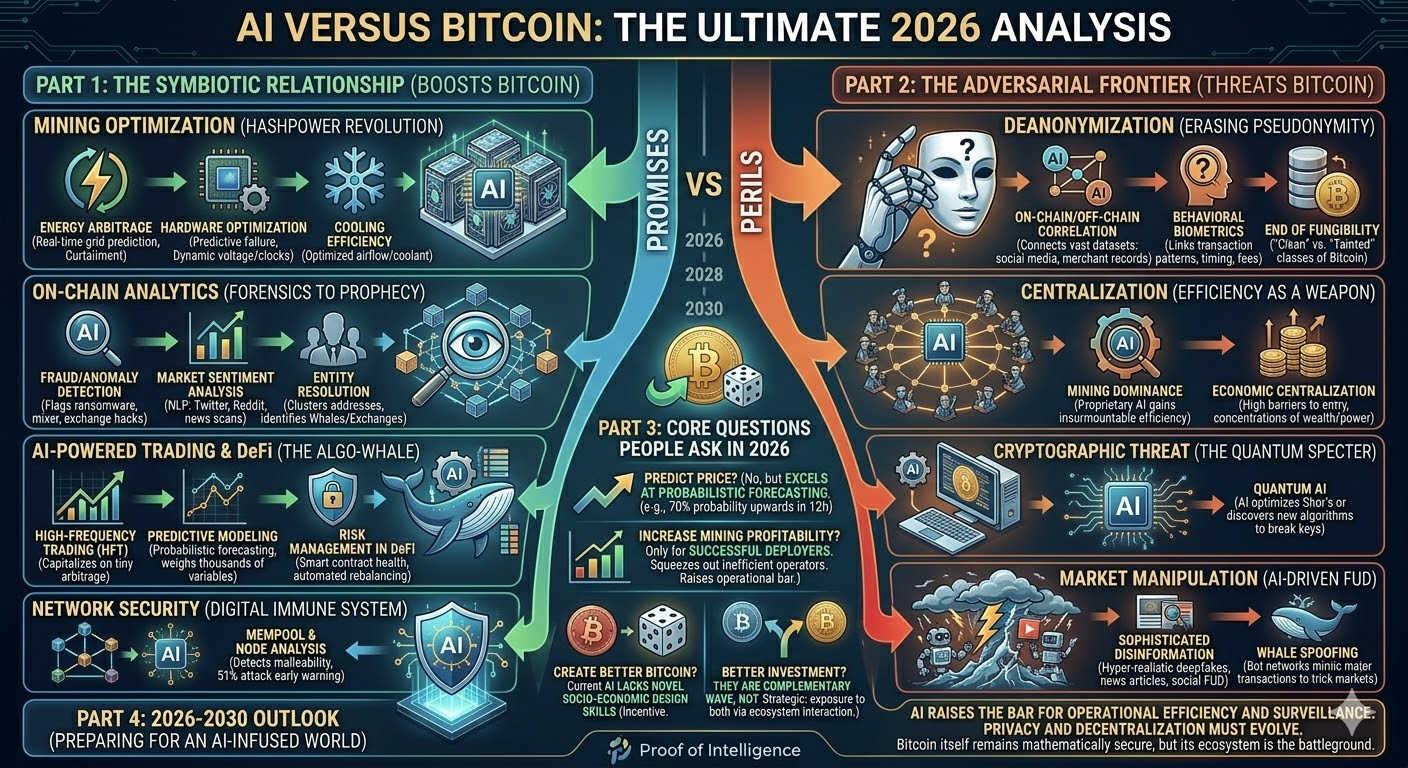
Artificial Intelligence will not "break" Bitcoin's fundamental cryptographic security but will profoundly reshape its ecosystem, acting as both a powerful catalyst for adoption and a formidable new threat to its privacy and market dynamics. AI will boost Bitcoin by optimizing mining, enhancing security analytics, and creating sophisticated trading algorithms, while simultaneously threatening it through advanced deanonymization techniques and potentially concentrating network power. This is not a battle of technologies, but a fundamental integration where AI becomes the most powerful tool for both attacking and defending the Bitcoin network.
Table of Contents
- Part 1: The Symbiotic Relationship: How AI Boosts Bitcoin
- Part 2: The Adversarial Frontier: How AI Threatens Bitcoin
- Part 3: Answering The Core Questions People Are Asking in 2026
- Part 4: The 2026-2030 Outlook: Preparing for an AI-Infused Bitcoin World
- Conclusion: A Tool, Not a Titan
Part 1: The Symbiotic Relationship: How AI Boosts Bitcoin
The synergy between AI and Bitcoin is not a future concept; it's a present reality that is rapidly accelerating. AI is acting as a force multiplier across every facet of the Bitcoin ecosystem, enhancing efficiency, security, and market intelligence.
AI in Mining Optimization: The Hashrate Revolution
Bitcoin mining is a game of razor-thin margins, where energy consumption is the primary variable cost. This is a perfect optimization problem for AI. Sophisticated machine learning models are now being deployed in major mining farms to achieve unprecedented levels of efficiency.
- Energy Arbitrage: AI algorithms monitor energy grids in real-time, predicting price fluctuations. They can automatically curtail mining operations during peak price hours and ramp up during periods of low-cost, surplus energy. This not only increases profitability but also helps stabilize energy grids, making miners a valuable partner to power providers.
- Hardware Optimization: Machine learning models analyze terabytes of data from ASICs (Application-Specific Integrated Circuits), monitoring temperature, hashrate variance, and silicon degradation. These models can predict hardware failures before they happen, schedule preventative maintenance, and dynamically adjust clock speeds and voltage to maximize the hashrate-per-watt ratio for each individual chip. This granular control can yield efficiency gains of 5-10%, a massive advantage in a competitive market.
- Cooling Efficiency: For large-scale immersion or air-cooled facilities, AI systems manage environmental controls. They optimize coolant flow, fan speeds, and airflow patterns based on external weather conditions and internal heat generation, further reducing the significant overhead costs associated with cooling.
AI in On-Chain Analytics: From Forensics to Prophecy
The Bitcoin blockchain is a public, immutable ledger, but interpreting its data is immensely complex. AI is the key to unlocking its secrets.
"The blockchain is a firehose of raw data. Humans can't hope to process it. AI can drink from the firehose and ask for more."
- Fraud and Anomaly Detection: AI models are trained on billions of historical transactions to recognize patterns associated with illicit activity, such as mixers, ransomware payments, and exchange hacks. They can flag suspicious transactions in real-time, providing exchanges and law enforcement with powerful new tools.
- Market Sentiment Analysis: Natural Language Processing (NLP) models scan millions of data points every second from sources like Twitter, Reddit, Telegram, and financial news outlets. They gauge market sentiment—fear, greed, uncertainty, excitement—and correlate it with on-chain data, like exchange inflows/outflows, to provide traders with a high-fidelity view of market psychology.
- Entity Resolution: Advanced AI clusters addresses and transactions to identify wallets belonging to the same entity (e.g., an exchange, a whale, a mining pool) with a high degree of confidence. This provides unprecedented transparency into the movements of major market players.
AI-Powered Trading & DeFi: The Rise of the Algo-Whale
Human traders, with their emotional biases and limited processing speed, are increasingly outmatched. The most sophisticated players in the market are AI-driven.
- High-Frequency Trading (HFT): AI bots execute thousands of trades per second, capitalizing on tiny arbitrage opportunities between exchanges that are invisible to human traders.
- Predictive Modeling: While no AI can perfectly predict the price, they can build sophisticated models that weigh thousands of variables—on-chain data, sentiment, macroeconomic indicators, order book depth—to assign probabilities to future price movements. These models drive automated strategies that manage billions of dollars in assets.
- Risk Management in DeFi: As DeFi (Decentralized Finance) protocols are built on Bitcoin layers like Rootstock or Stacks, AI will be critical. AI models can monitor smart contract health, simulate market crash scenarios to stress-test lending protocols, and automatically rebalance portfolios to mitigate risk.
AI for Network Security: A Digital Immune System
AI can also be used to defend the Bitcoin network itself. By analyzing mempool data and node communication patterns, an AI can detect sophisticated attacks in their infancy, such as transaction malleability exploits or attempts at a 51% attack, and alert the network or take automated defensive measures.
Part 2: The Adversarial Frontier: How AI Threatens Bitcoin
For every beneficial application of AI, there is a corresponding adversarial use. The same tools that boost Bitcoin can be turned against it, attacking its core value propositions of privacy, decentralization, and security.
The Deanonymization Threat: Erasing Pseudonymity
This is arguably the most immediate and potent threat AI poses to Bitcoin. The pseudonymity of Bitcoin relies on the difficulty of linking a real-world identity to a public address. AI is exceptionally good at finding signals in noise, making it the ultimate tool for blockchain surveillance.
- On-Chain/Off-Chain Correlation: As detailed in our intelligence briefing on 'ChronoGraph,' AI systems can ingest massive, disparate datasets—social media, KYC data from exchange leaks, merchant transaction records, forum posts—and correlate them with on-chain transaction data. A single off-chain data point, like a Reddit user accidentally posting their address, can be the thread an AI pulls to unravel an entire network of transactions.
- Behavioral Biometrics: AI can analyze the "fingerprint" of a user's transaction patterns—the time of day they transact, the specific fees they use, the software they broadcast from. It can use these behavioral biometrics to link otherwise disconnected addresses, asserting they are likely controlled by the same person.
- The End of Fungibility: The ultimate consequence is a serious blow to fungibility. If an AI can flag a coin as having passed through a wallet associated with a sanctioned entity three years ago, that coin could be blacklisted by exchanges. This creates two classes of Bitcoin: "clean" and "tainted," undermining the idea that 1 BTC is always equal to 1 BTC.
The Centralization Threat: Efficiency as a Weapon
Bitcoin's security is rooted in its decentralization. If one entity controls too much of the network's hashrate, it can threaten the integrity of the blockchain. AI, by supercharging efficiency, could paradoxically lead to centralization.
- Mining Dominance: A mining pool that develops a proprietary AI yielding a 10% efficiency gain has an almost insurmountable advantage. They can out-compete other miners, driving them out of business and consolidating hashrate. Over time, this could lead to a scenario where only a handful of hyper-efficient, AI-optimized entities control the majority of the network's mining power.
- Economic Centralization: The cost of developing and training cutting-edge AI models is immense, requiring vast computational resources and specialized talent. This creates a high barrier to entry, meaning only the most well-capitalized players can afford to deploy AI in mining and trading, further concentrating wealth and power.
The Cryptographic Threat: The Quantum AI Specter
This threat is more distant but is the most existential. Bitcoin is secured by two key cryptographic primitives: the SHA-256 hashing algorithm and the Elliptic Curve Digital Signature Algorithm (ECDSA). While currently unbreakable by classical computers, the advent of quantum computing poses a known future threat.
Where does AI fit in? Researchers are exploring the use of AI, particularly machine learning, to discover new quantum algorithms or to optimize existing ones like Shor's algorithm, which can break ECDSA. An AI-accelerated breakthrough in quantum computing could drastically shorten the timeline for a potential cryptographic attack on Bitcoin. While the network can and would hard-fork to quantum-resistant algorithms, the transition would be chaotic and contentious.
The Market Manipulation Threat: AI-Driven FUD
Markets are driven by narratives and emotions, and AI is the ultimate tool for narrative warfare.
- Sophisticated Disinformation: Adversarial AIs can generate thousands of hyper-realistic "news" articles, social media posts, and deepfake videos to spread fear, uncertainty, and doubt (FUD) or irrational optimism (FOMO). These campaigns can be targeted at specific communities and timed to coincide with market-moving events, causing massive volatility that AI trading bots can then exploit.
- Whale Spoofing: An AI can control a network of thousands of bots to mimic the on-chain behavior of a large whale, tricking market analysts and other algorithms into believing a massive sell-off or buy-up is imminent, triggering a cascade of liquidations.
Part 3: Answering The Core Questions People Are Asking in 2026
To cut through the noise, let's authoritatively answer the most common questions about the intersection of AI and Bitcoin.
Can AI accurately predict the price of Bitcoin?
No, AI cannot accurately and consistently predict the specific price of Bitcoin at a future point in time. The market is a complex adaptive system with too many random variables and reflexive feedback loops (i.e., the prediction itself can influence the outcome). However, AI is exceptionally powerful at probabilistic forecasting. It can analyze countless variables to state that there is a "70% probability of the price moving upwards in the next 12 hours based on current exchange outflows and positive social media sentiment." Hedge funds and trading firms use these probabilistic advantages to build profitable strategies over time, but they are not crystal balls.
Will AI make Bitcoin mining more profitable?
Yes, AI will make Bitcoin mining more profitable for the operators who successfully deploy it, but it will make it less profitable for those who don't. It is not a tide that lifts all boats. AI raises the bar for operational efficiency. Miners who leverage AI for energy arbitrage and hardware optimization will lower their cost basis, allowing them to remain profitable at lower Bitcoin prices. This will squeeze out smaller or less technologically advanced miners, contributing to the centralization pressures discussed earlier.
Could an AI create a better version of Bitcoin?
This is a highly speculative but fascinating question. In its current form, AI cannot "create" a decentralized monetary system like Bitcoin. AI models are excellent at optimization and pattern recognition, but they lack the ability to invent novel socio-economic systems. Bitcoin's genius lies in its incentive structure, its game theory, and its fusion of cryptography, distributed systems, and economics. An AI could potentially be tasked with designing a more technically efficient consensus mechanism or a more private transaction type, but it could not single-handedly design a system that achieves the global, trustless social consensus that Bitcoin has. The future may hold "Decentralized AI Agents" that manage networks, but that is a paradigm beyond our current technological horizon.
Is AI a bigger investment opportunity than Bitcoin?
Comparing AI and Bitcoin is a category error; they are not competing assets but complementary technological waves. Bitcoin is a decentralized monetary asset, a finished protocol. Its value proposition is scarcity and censorship resistance. AI is a broad technological field, an ingredient that will be baked into every industry. The investment opportunity in "AI" is not a single asset but a vast ecosystem of companies building hardware (like Nvidia), developing models (like OpenAI), and applying AI to specific sectors. The smartest strategy is not to choose between them, but to understand how they will interact. Investing in companies that apply AI to the Bitcoin ecosystem (e.g., analytics firms, mining tech) is a way to gain exposure to both trends simultaneously.
Part 4: The 2026-2030 Outlook: Preparing for an AI-Infused Bitcoin World
The next four years will be defined by the accelerating integration of these two technologies. We can expect several key trends to dominate:
- The Privacy Arms Race: The rise of AI surveillance will force privacy to the forefront of Bitcoin development. The adoption of Taproot, CoinJoins, and Layer 2 privacy solutions will become a primary focus for developers and users.
- AI on Layer 2: The computational overhead of running complex AI models on Bitcoin's base layer is prohibitive. Expect to see AI-powered applications flourish on second layers, such as AI agents managing Lightning Network liquidity or running decentralized prediction markets on sidechains.
- Regulatory AI: Governments will not stand idly by. They will heavily invest in their own AI analytics platforms to monitor blockchain activity for tax compliance and law enforcement, creating a constant tension with privacy advocates.
- The AI Agent Economy: As AI agents become more autonomous, they will need a native currency for machine-to-machine payments. Bitcoin, with its programmatic nature and settlement finality, is a prime candidate to become the reserve currency for this emerging autonomous economy.
Conclusion: A Tool, Not a Titan
AI will neither be Bitcoin's savior nor its destroyer. It is the most powerful tool ever created, and like any tool, its impact is defined by its user. For those building, securing, and investing in the Bitcoin network, AI offers a chance to create unprecedented efficiency and intelligence. For those seeking to control, surveil, or attack the network, it provides a formidable weapon.
Bitcoin's core protocol, a marvel of mathematical and game-theoretic design, will likely remain secure against any direct AI onslaught for the foreseeable future. The real battleground is the ecosystem built around it. The future of Bitcoin in the age of AI will be defined by a dynamic, escalating contest between AI-powered centralization and surveillance on one side, and privacy-enhancing cryptography and the ethos of decentralization on the other. AI isn't breaking Bitcoin; it's forcing it to evolve.
``` ```json { "@context": "https://schema.org", "@type": "FAQPage", "mainEntity": [ { "@type": "Question", "name": "Will AI break Bitcoin's security?", "acceptedAnswer": { "@type": "Answer", "text": "No, AI is not expected to break Bitcoin's core cryptographic security (SHA-256 and ECDSA) with current technology. The primary threat is not to the protocol's encryption but to the pseudonymity of its users through advanced on-chain analysis. A long-term, theoretical threat exists if AI significantly accelerates the development of quantum computing." } }, { "@type": "Question", "name": "Can AI accurately predict the price of Bitcoin?", "acceptedAnswer": { "@type": "Answer", "text": "AI cannot predict the exact price of Bitcoin with consistent accuracy due to the market's complexity and randomness. However, it excels at probabilistic forecasting, analyzing thousands of variables to identify trends and assign probabilities to future price movements, which is highly valuable for trading strategies." } }, { "@type": "Question", "name": "How does AI boost the Bitcoin network?", "acceptedAnswer": { "@type": "Answer", "text": "AI boosts the Bitcoin network in several key ways: 1) It optimizes mining operations by managing energy consumption and hardware for greater efficiency. 2) It enhances on-chain analytics for fraud detection and market sentiment analysis. 3) It powers sophisticated trading algorithms and risk management for DeFi. 4) It can be used to monitor network health and detect potential attacks." } }, { "@type": "Question", "name": "What is the biggest AI threat to Bitcoin?", "acceptedAnswer": { "@type": "Answer", "text": "The single biggest and most immediate threat AI poses to Bitcoin is deanonymization. By correlating on-chain transaction data with vast off-chain datasets (social media, KYC leaks, etc.), AI can link pseudonymous addresses to real-world identities, which threatens user privacy and the fungibility of Bitcoin." } }, { "@type": "Question", "name": "Is AI a better investment than Bitcoin?", "acceptedAnswer": { "@type": "Answer", "text": "They are fundamentally different types of opportunities. Bitcoin is a decentralized monetary asset, while AI is a broad field of technology. Investing in 'AI' means investing in a diverse ecosystem of companies. A strategic approach is to consider how they interact, such as investing in firms that apply AI technology to the Bitcoin ecosystem, thereby gaining exposure to both megatrends." } } ] } ```


